
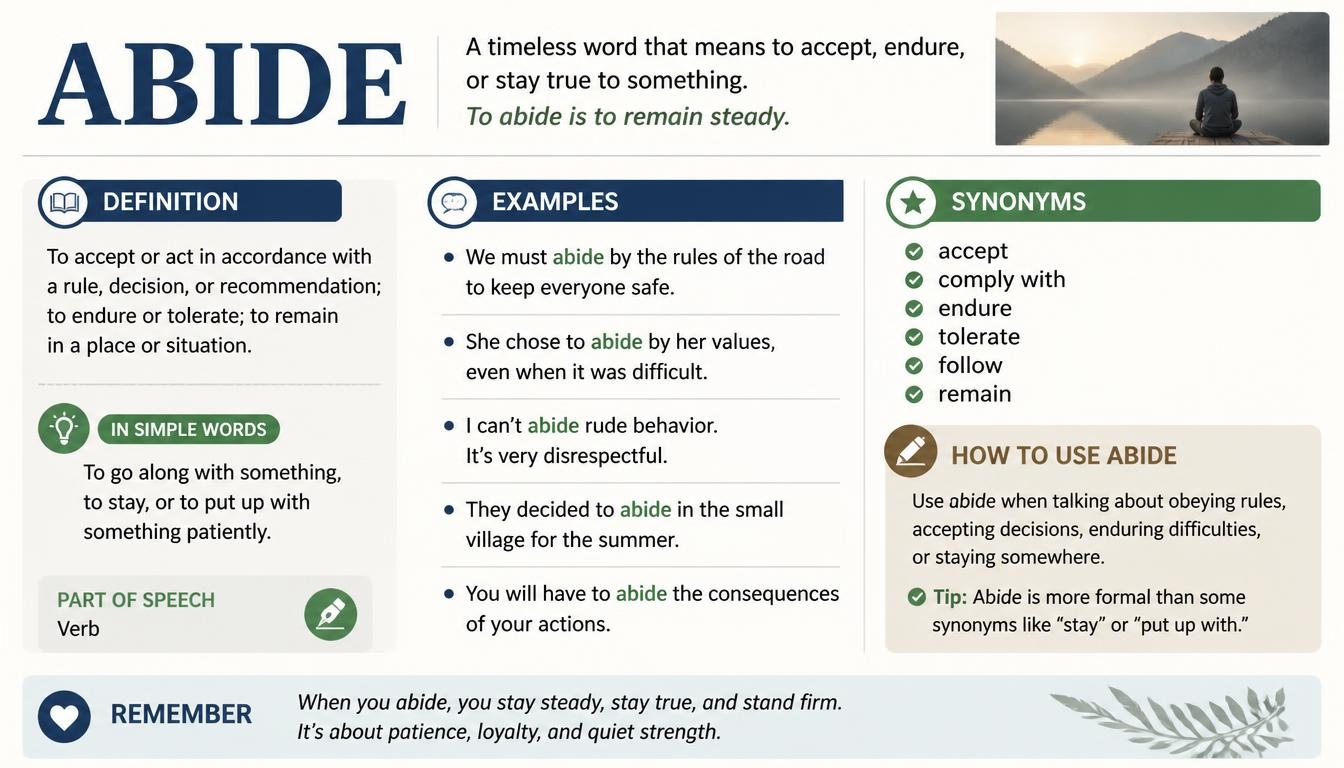

The word abide is one of those English words that feels simple at first, but becomes surprisingly interesting when you look closer. You may have seen it in a sentence like “I cannot abide this behavior,” or perhaps in the familiar phrase “abide by the rules.” Same word, but the meaning shifts a little depending on how it is used, which can be confusing sometimes.
So, what does abide mean? In modern English, it can mean to tolerate, endure, remain, stay, or accept and follow something, depending on the context. It is an old word with a long history, and some of its older meanings sound more literary than everyday English.
Abide Meaning in English
The basic meaning of abide is connected with remaining, enduring, or putting up with something. The exact meaning depends heavily on the sentence around it, so you should not treat it as having just one fixed definition.
In everyday English, abide commonly appears in two important patterns: “abide by” and “cannot abide.” These have quite different meanings, which is where learners can get tripped up a bit.
Abide by means to follow, obey, or accept a rule, agreement, decision, or requirement. For example, “Everyone must abide by the school rules.”
When someone says, “I can’t abide loud music,” abide means tolerate or bear patiently. In this use, the speaker is saying that they strongly dislike something and do not want to put up with it.
Abide Definition
A useful abide definition is “to remain, continue, endure, tolerate, or follow,” depending on the construction in which the word appears.
The word can describe a person staying somewhere, something continuing for a long period, or someone accepting something without objection. English has kept these different shades of meaning alive, even though some are much more common than others today.
The abide verb is therefore more flexible than it may first appear. It can describe physical staying, emotional tolerance, or obedience to a rule.
For example:
- “They chose to abide in the village for another month.”
- “She could not abide his rude behavior.”
- “You must abide by the agreement.”
- “Their friendship continued to abide through difficult years.”
The last example sounds literary, while the first three show more recognizable uses.
Abide Pronunciation
The standard abide pronunciation is /əˈbaɪd/. It sounds approximately like “uh-BYDE.”
The pronunciation begins with a short unstressed “uh” sound, followed by the stronger “byde” sound. The phonetic form is often written as ə-ˈbīd in dictionary-style notation.
The important part is that the second syllable receives the stress. Saying “AB-ide” would sound incorrect in normal English.
You will hear this pronunciation in phrases such as “abide by,” “cannot abide,” and “abiding friendship.” Once you hear it a few times, it becomes pretty easy to recognize.
What Does Abide Mean in Different Contexts?
The easiest way to understand abide is to separate its major meanings rather than memorize one dictionary sentence.
One meaning is to remain or stay. In older or literary English, a person might abide somewhere, meaning they remain or dwell there for a period of time.
Another meaning is to endure or withstand. Something that abides can continue despite difficulty or the passing of time.
A third meaning is to tolerate or bear patiently. This is the meaning found in “I cannot abide that.”
Finally, abide by means to obey, accept, or follow something. It usually involves rules, decisions, agreements, instructions, or principles.
That small word “by” really matters here.
Abide By Meaning
The abide by meaning is to obey, follow, or accept a rule, agreement, decision, or condition.
For example, if a contract says that both parties must abide by its terms, they are expected to follow those terms. If a person agrees to abide by a court decision, they agree to accept and follow that decision.
Some examples include:
- Everyone must abide by the rules.
- The players agreed to abide by the referee’s decision.
- Employees are expected to abide by company policies.
- Both sides promised to abide by the agreement.
- Visitors should abide by the safety instructions.
Here, abide by is close to “follow,” “obey,” “comply with,” and “respect.” It doesn’t normally mean simply staying somewhere.
Can’t Abide Meaning
The can’t abide meaning is quite different. When someone says “I can’t abide it,” they mean they cannot tolerate, bear, or put up with it.
For example, “I can’t abide dishonesty” means “I cannot tolerate dishonesty.” The expression can sound somewhat strong, and in modern conversation it may also have a slightly old-fashioned or dramatic flavor.
You might hear:
- “I can’t abide rude behavior.”
- “She cannot abide being interrupted.”
- “He can’t abide unnecessary arguments.”
- “I cannot abide that kind of attitude.”
The expression cannot abide has a stronger emotional feeling than simply saying “I don’t like.” It suggests that the person finds the thing especially unpleasant or unacceptable.
Abide Synonym
There are several useful abide synonym choices, but no single synonym works perfectly in every sentence.
When abide means tolerate, possible synonyms include:
- tolerate
- bear
- endure
- stand
- suffer
- put up with
- withstand
- accept
When abide means remain, alternatives include:
- remain
- stay
- dwell
- continue
- persist
- last
- endure
When abide by means follow, suitable alternatives include:
- obey
- follow
- comply with
- accept
- respect
- observe
This is why replacing “abide” automatically with one synonym can sometimes make a sentence sound wrong. Context is doing more work than it first seems.
Abide Synonyms and Antonyms
The best abide synonyms and antonyms depend on which sense of the word is being used.
For the tolerance sense, synonyms include tolerate, bear, endure, stand, suffer, and “put up with.” Possible opposites include reject, resist, oppose, dislike, and refuse.
For the remaining sense, synonyms include stay, remain, continue, dwell, persist, and last. Antonyms can include leave, depart, disappear, end, or cease.
For the “abide by” sense, synonyms include obey, follow, comply, accept, and observe. Antonyms may include disobey, violate, reject, break, or ignore.
So the abide antonym changes with the meaning, which is a useful little detail for English learners.
Abide in Meaning
The phrase abide in generally carries the idea of remaining in, dwelling in, or continuing within something. It can sound formal or literary in ordinary English.
For instance, “They abide in the old house” means they remain or live there. Today, most speakers would probably say “They live in the old house” or “They stay in the old house.”
The phrase becomes especially significant in religious language, where abide in me refers to continuing in a close relationship with Christ.
This is one reason the word has survived so strongly in religious writing, poetry, and traditional literature.
Abide in the Bible
The biblical meaning of abide is strongly connected with remaining, continuing, dwelling, or maintaining a relationship.
One of the best-known examples is the phrase “abide in me,” associated with Jesus in the Gospel of John. In this context, abiding suggests remaining closely connected rather than simply visiting or temporarily staying.
The expression is therefore richer than a basic physical location. It conveys ideas such as faithfulness, relationship, constancy, and continued connection.
Another familiar expression is “abide in the house of the Lord.” Here again, the sense is connected with dwelling or remaining.
Religious usage helped preserve older shades of the word that are less common in casual modern speech.
Abide Examples in Sentences
Learning how to use abide becomes much easier when you see several meanings side by side.
- I cannot abide his constant complaining.
- You must abide by the terms of the agreement.
- The family continued to abide in the countryside.
- Their friendship remained abiding despite the distance.
- She agreed to abide by the final decision.
- Some memories seem to abide long after childhood.
- He could not abide the smell of smoke.
- The residents agreed to abide by the new regulations.
- The old tradition continued to abide through generations.
- They planned to abide in town until winter ended.
Notice how the meaning changes depending on whether the word is followed by “by,” used with a place, or used in a tolerance expression.
Abide in a Sentence
A simple abide in a sentence can demonstrate the word without making things complicated.
“Everyone agreed to abide by the rules.”
Here, abide by means obey or follow.
Another example is:
“I cannot abide unnecessary cruelty.”
In this sentence, abide means tolerate or bear.
For the older sense, you could write:
“They chose to abide in the village.”
That means they chose to remain or dwell there, although “stay” or “live” would sound more natural in most modern conversations.
Abide vs Endure
The difference between abide vs endure is small in some contexts, but important in others.
Endure usually emphasizes going through something difficult, painful, or unpleasant without giving up. A person can endure hardship, pain, pressure, or a difficult period.
Abide, when used in the tolerance sense, focuses more on whether someone can tolerate or accept something.
For example, “She endured years of hardship” sounds natural. “She abided years of hardship” does not sound natural in contemporary English.
But “I cannot abide his behavior” is perfectly understandable. Saying “I cannot endure his behavior” is possible too, though it gives the sentence a slightly different emotional weight.
Abide vs Tolerate
When comparing abide vs tolerate, the two can overlap strongly.
“I cannot abide dishonesty” and “I cannot tolerate dishonesty” communicate almost the same basic idea.
The difference is mostly one of style and usage. Tolerate is much more common in modern everyday English, while abide can sound stronger, more literary, or slightly old-fashioned.
That doesn’t make abide useless, though. Certain phrases, especially “abide by,” remain completely normal.
Abide vs Remain
The difference between abide vs remain is mainly about modern usage.
Both words can describe continuing in a place or state, but remain is far more common in contemporary English. “Please remain here” sounds perfectly ordinary, while “Please abide here” sounds unusual unless a deliberately formal or literary tone is intended.
In older English, however, abide could naturally carry the meaning of stay or remain.
This is a good example of how language changes without completely throwing old words away.
Abide Past Tense and Word Forms
The abide past tense can be abided or abode, depending on the sense and style.
The form abided is especially common when referring to following or complying with something, as in “They abided by the agreement.”
The older or literary form abode can mean remained or stayed. For example, “He abode there for many years” sounds distinctly literary today.
Other forms include abides and abiding.
The noun abidance refers to the act or condition of abiding, though it is relatively uncommon in ordinary modern conversation. An abider would be a person who abides, but this word is rare and usually not needed.
Abiding Meaning
The abiding meaning is connected with something that continues, remains, or lasts for a long time.
An abiding friendship is a friendship that continues over the years. An abiding love is a love that remains strong and lasting.
You may also encounter phrases such as:
- an abiding friendship
- an abiding love
- abiding faith
- abiding respect
- abiding memories
Here, abiding carries a warm sense of permanence, stability, and constancy.
It is not merely something that lasted for five minutes and wandered away; it suggests something that stays with us.
Abidance Meaning
The abidance meaning relates to the state or act of remaining, continuing, or complying.
It is not a word most people use in casual conversation. You are much more likely to see “abiding,” “abide,” or “abide by” than “abidance.”
Still, understanding the word helps when reading formal, historical, religious, or literary English, where unusual forms sometimes appear without warning.
Abode Meaning
The word abode is another interesting form connected with abide.
Today, abode usually means a home, residence, or place where someone lives. You might hear “a humble abode,” which means a modest home.
Historically, however, abode also functioned as a past form of abide, particularly with the sense of remaining or staying.
This gives the word an interesting double life: one meaning relates to a dwelling place, while another belongs to the older verb forms of abide.
Abide Etymology and Word History
The abide etymology reaches deep into the history of the English language.
The word comes from Old English abīdan, which carried the idea of waiting, remaining, or staying. It later developed through Middle English forms such as abiden.
The related word bide is also important. Historically, “bide” carried meanings associated with waiting, remaining, or enduring.
The history of the word helps explain why modern English has several seemingly different meanings. They are not random meanings thrown into one linguistic basket; they developed from related ideas of waiting, remaining, enduring, and continuing.
The word has been part of English for many centuries, with evidence reaching back to before the 12th century.
Historical Meaning of Abide
The historical meaning of abide was often closer to “remain,” “wait,” “stay,” or “await” than the modern tolerance sense many learners recognize.
In older writing, someone could “abide” in a location, meaning they stayed there. The word could also describe waiting for something to happen.
Over time, different uses became more specialized. “Abide by” developed its strong association with following rules or agreements, while “cannot abide” became associated with intolerance.
Language is a bit like an old house in this way. New rooms get added, old rooms get used less, but some doors still open if you know where to push.
Abide in Literature
The word appears frequently in older literature, where its broader range of meanings is much easier to see.
Writers such as Shakespeare used language that may sound unusual to modern readers, and forms related to abiding can carry meanings of waiting, remaining, or enduring.
In Henry IV, Part II, for example, Shakespeare’s language reflects an English vocabulary in which words like abide could carry broader meanings than they usually do today.
The word also appears in the works of writers such as Daniel Defoe and Alfred Tennyson, among many others. Literary usage often preserves words and meanings that everyday speech gradually stops using.
The Dude Abides
Modern popular culture gave abide a surprisingly memorable appearance through The Big Lebowski.
The character The Dude, played by Jeff Bridges, is associated with the phrase “The Dude abides.” The line became one of the most recognizable expressions connected with the film.
Here, “abides” carries a deliberately relaxed sense of remaining or continuing to exist. It also fits the character’s unhurried personality rather perfectly.
So when someone says The Dude abides, they are using an old-fashioned verb in a distinctly modern cultural setting. Funny how language travels.
Abide vs Continue and Persist
The comparisons abide vs persist and abide vs continue are useful because these words can overlap around the idea of lasting.
Continue simply means to keep going. Persist often suggests continuing despite resistance or difficulty.
Abide, in its older sense, can also mean remain or continue, but it is less common for ordinary modern statements.
For example, “The rain continued” is completely natural. “The rain abided” would sound poetic or archaic.
Likewise, “She persisted despite criticism” sounds normal, while “She abided despite criticism” would require a very particular literary context.
How to Remember the Meaning of Abide
A simple way to remember abide is to connect it with three ideas: remain, tolerate, and follow.
If something remains, it can abide.
If you cannot tolerate something, you may say you cannot abide it.
If you follow a rule or agreement, you abide by it.
Those three patterns cover a large portion of the word’s useful modern meaning. Once they become familiar, the word stops feeling mysterious.
Quick Guide to Abide
Here is a compact way to understand the major uses:
- abide = remain, stay, or endure in an older/literary sense
- abide = tolerate or bear
- abide by = follow or obey
- abiding = lasting, continuing, or permanent
- abided = commonly used past form, especially with “abide by”
- abode = older past form of abide and also a noun meaning home
- abidance = the act or condition of abiding
- can’t abide = cannot tolerate
- abide in = remain or dwell in
- abide in me = remain in close spiritual relationship, especially in biblical language
Frequently Asked Questions
abide meaning
“Abide” means to tolerate, endure, accept, or remain in a particular state or place. Its meaning depends on the context in which it is used.
abide
Abide is a verb meaning to tolerate something, remain somewhere, or continue to exist. It can also mean to accept and follow a decision or rule.
abide definition
The definition of “abide” includes to endure or tolerate something and to remain stable or continue. In “abide by,” it means to accept and follow a rule, decision, or agreement.
abided
“Abided” is the past tense and past participle of “abide.” It can mean tolerated, endured, remained, or followed a rule or decision.
define abide
To define “abide” simply, it means to tolerate, endure, remain, or accept something. The phrase “abide by” means to follow or obey a rule, decision, or agreement.
Read ARticul: https://ytmeaning.com/mundane-meaning/
Final Thoughts on Abide Meaning
The beauty of the abide meaning is that the word carries a sense of staying power. Whether it means to tolerate something, remain somewhere, endure difficulty, or follow an agreement, there is an underlying idea of continuing rather than simply passing through.
If you remember only a few things, remember these: abide by means follow, cannot abide means cannot tolerate, and the older sense of abide can mean remain or stay.
Its related forms tell an equally interesting story. Abiding describes something lasting, abided is a common past form, and abode has both historical and modern uses. The word’s journey from Old English abīdan through Middle English abiden into today’s English shows how meanings can change while still carrying traces of their oldest roots.
So the next time you encounter “abide,” don’t rush past it as just another old-fashioned word. Look at the sentence around it. Is somebody following a rule, tolerating something, waiting, or remaining somewhere? That little bit of context usually unlocks the meaning.
And perhaps that is the most fitting lesson hidden inside the word itself: abide has lasted because language, like people, sometimes refuses to disappear completely. It stays, changes a little, and carries its old stories forward.