

There are some internet abbreviations that look almost mysterious the first time you see them. ISTG is one of those tiny combinations of letters that can carry a surprisingly strong emotion. You might spot it in a text, Snapchat message, Instagram comment, or a late-night group chat and wonder, “Wait, what does ISTG mean?”
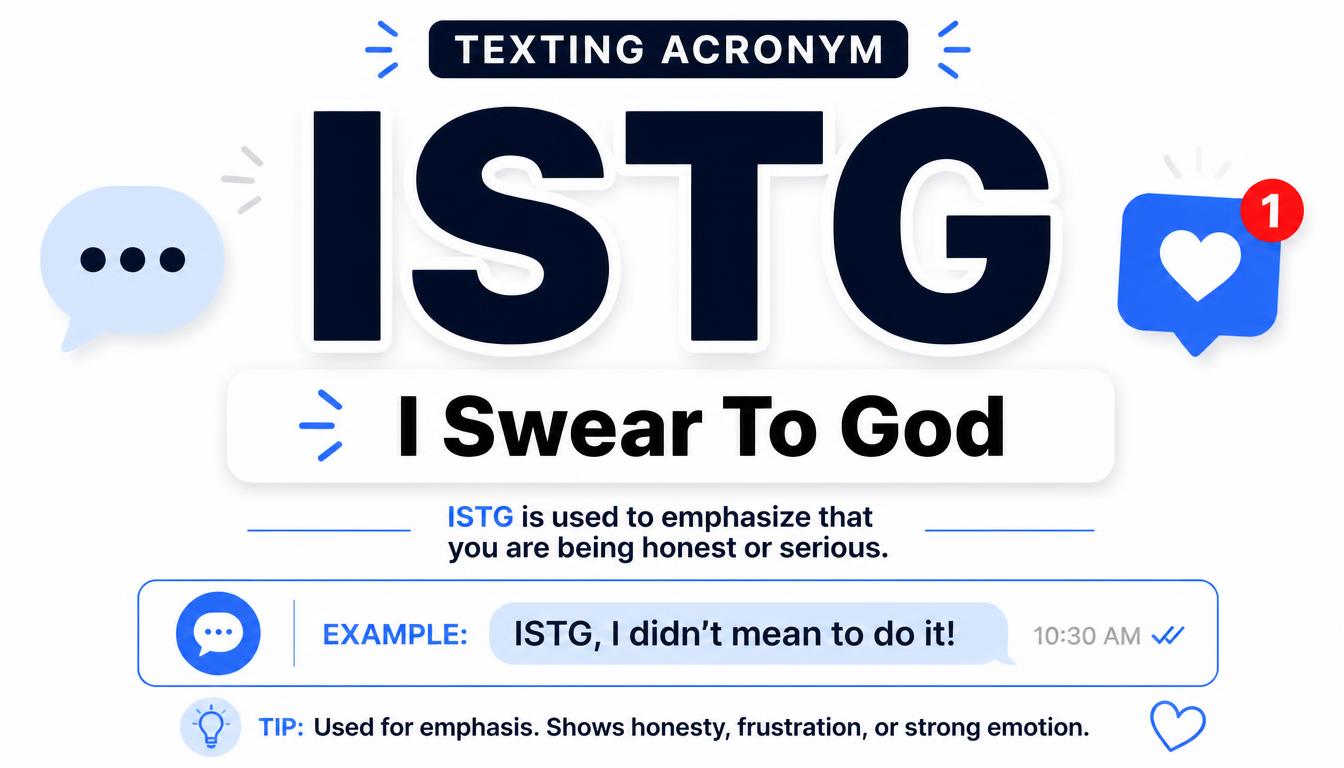
In most everyday conversations, ISTG means “I swear to God.” It is an acronym and a form of online slang used to add emphasis, express strong feelings, or make a statement sound especially sincere. Depending on the conversation, it can show honesty, frustration, surprise, disbelief, or even playful exaggeration.
The interesting part is that ISTG doesn’t always feel as serious as the words behind it. People use this text slang casually, sometimes jokingly, and sometimes when they genuinely want someone to believe them. So the meaning isn’t just hidden in the letters; it lives in the mood of the conversation too.
What Does ISTG Mean in Text?
The most common ISTG meaning in text is “I swear to God.” It is an abbreviation people use in text messaging, social media, and online chat when they want to strongly emphasize what they are saying.
For example:
- “ISTG, I didn’t take your charger.”
- “ISTG, that was the funniest thing I’ve ever seen.”
- “ISTG, if my phone dies again, I’m buying a new one.”
In each example, the abbreviation adds emotional weight to the sentence. It can communicate truth, frustration, excitement, or strong belief.
Sometimes a person may type ISTG simply because writing the whole phrase feels too formal or takes a few extra seconds. Internet language has a funny habit of shrinking whole sentences into three or four letters, and ISTG fits perfectly into that world.
What Does ISTG Stand For?
So, what does ISTG stand for? It stands for “I swear to God.”
The phrase is based on the idea of making a serious swear or sacred oath about the truth of a statement. However, online users don’t necessarily intend it as a literal religious oath every time they type it.
For some people, “I swear to God” is simply a familiar expression used for emphasis. For others, the religious reference may feel more serious. That’s why understanding the context matters before assuming exactly how strongly someone means it.
You could think of ISTG as a verbal highlighter. It tells the reader, “Pay attention, I’m really serious about this,” even when the conversation itself is casual.
ISTG Meaning in Text Messaging and Online Chat
The ISTG meaning in text can change slightly depending on the situation. A person might use it to confirm something, express annoyance, or react dramatically to an unexpected moment.
Consider these examples:
- “ISTG, you always make me laugh.” — affectionate emphasis
- “ISTG, I already told you yesterday.” — frustration
- “ISTG, that movie ending shocked me.” — strong reaction
- “ISTG I saw him at the mall.” — confirmation
- “ISTG, you’re not going to believe this.” — building suspense
This is why a slang dictionary definition alone doesn’t always explain how the expression feels. The surrounding words, punctuation, relationship between the people, and even the timing of the message can change the tone.
A simple “ISTG 😂” may be playful, while “ISTG I’m telling the truth” can sound much more serious.
ISTG Slang: Why People Use It
ISTG slang became popular because online communication often needs quick ways to express emotions. Typing three letters is faster than writing “I swear to God,” especially during a rapid conversation.
But speed isn’t the only reason.
The abbreviation can also make a message feel more natural. Friends often use internet slang, texting abbreviations, and other slang terms because these expressions make digital communication sound closer to spoken conversation.
For example:
- “I swear to God, that was crazy.”
- “ISTG that was crazy.”
The second version feels shorter, more casual, and more like something you’d see in a group chat.
ISTG Meaning on Snapchat
If you’re wondering about ISTG meaning on Snapchat, it generally has the same meaning: “I swear to God.”
Someone might send:
“ISTG you disappeared for three hours 😭”
Here, the person probably isn’t making a formal oath. They’re expressing frustration or exaggerating the situation in a humorous way.
Snapchat conversations often contain highly informal language, so ISTG can appear alongside emojis, shortened words, and other casual expressions. The emotional meaning comes from the entire message rather than the acronym alone.
ISTG Meaning on Instagram
The ISTG meaning on Instagram is also usually “I swear to God.”
You might see it in comments, captions, direct messages, or replies.
For example:
“ISTG this outfit is perfect.”
The person is emphasizing their opinion. They are essentially saying, “I genuinely mean this.”
In another situation:
“ISTG, I thought that was you.”
Here, ISTG emphasizes disbelief or surprise rather than making a literal oath.
Instagram’s casual communication style makes this abbreviation pretty common among people who already understand internet slang.
ISTG Meaning on TikTok
The ISTG meaning on TikTok usually remains the same, but TikTok’s highly expressive culture can make the abbreviation even more dramatic.
A comment might say:
“ISTG this is the most relatable video ever.”
Or:
“ISTG I wasn’t ready for that ending.”
In these cases, ISTG adds emotional intensity. It can make an ordinary reaction sound stronger, funnier, or more dramatic.
That’s one reason short abbreviations work so well on social platforms. A few letters can carry an entire emotional attitude.
ISTG in Chat: Common Uses
When people ask what does ISTG mean in chat, the simplest answer is “I swear to God,” but its purpose can vary.
Confirming the Truth
Someone may use ISTG to make another person believe them.
“ISTG, that’s exactly what happened.”
The acronym strengthens the speaker’s credibility and suggests that they want to be trusted.
Expressing Frustration
It can also appear when someone is annoyed.
“ISTG, my Wi-Fi keeps disconnecting.”
Here, the phrase communicates frustration more than a literal oath.
Showing Surprise
ISTG can make a surprised reaction stronger.
“ISTG, he actually won!”
The writer is showing genuine excitement or disbelief.
Responding to Doubt
If someone doesn’t believe you, ISTG can work as a quick response.
“You think I’m lying? ISTG, I’m not.”
It signals that the speaker wants to establish trust and reinforce their claim.
ISTG Examples in Everyday Messages
Understanding an ISTG example sentence is often easier than memorizing a definition. Here are several natural examples:
- “ISTG, I left my keys right here.”
- “ISTG this cat knows exactly what she’s doing.”
- “ISTG, you scared me.”
- “ISTG I have told you this five times.”
- “That was the best burger ever, ISTG.”
- “ISTG, I wasn’t even there.”
- “You need to watch this movie, ISTG.”
- “ISTG, why does this always happen to me?”
- “I thought you were joking, ISTG.”
- “ISTG, I’m never doing that again.”
Notice how the same acronym can sound funny, annoyed, excited, defensive, or completely sincere depending on the sentence.
ISTG and Similar Slang Expressions
ISTG isn’t the only expression people use when they want to emphasize truth or honesty. Internet communication has created a whole little family of expressions that can sometimes overlap.
For example:
- TBH — “To be honest”
- No cap — meaning “no lie” or “I’m being truthful”
- Bet — often meaning “okay,” “sure,” or “you bet”
- BION — “Believe it or not”
- tru dat — “true that”
- fo sho — “for sure”
- SOOF — sometimes used as “Swear on our friendship”
- BLVMOT — used informally for “Believe me on that”
- COT — can refer to “Circle of trust”
- ONB — a slang abbreviation whose meaning depends heavily on context
These expressions aren’t perfect replacements for ISTG. No cap, for instance, emphasizes honesty, while ISTG can combine honesty with frustration, disbelief, excitement, or commitment.
How to Use ISTG Naturally
If you’re learning how to use ISTG, the easiest rule is to use it when you want to add emotional emphasis to something you’re saying.
It works particularly well in casual conversations with friends, relatives, classmates, or people you regularly communicate with online.
For example:
“ISTG, you have to try this place.”
This sounds casual and enthusiastic.
Another example:
“ISTG, I didn’t know about the party.”
Here, the abbreviation emphasizes the speaker’s honesty.
You could also use it humorously:
“ISTG, my dog judges me every morning.”
Nobody is expecting a literal oath there. It’s simply playful communication.
When to Use ISTG
Knowing when to use ISTG is just as important as knowing its definition.
Use it when the conversation is informal and the other person understands text slang. It can be especially natural in friendly conversations, social media messages, comments, and casual group chats.
However, ISTG isn’t normally appropriate for formal emails, professional reports, academic writing, or serious business communication. Writing “ISTG” to your boss probably won’t communicate the same polished credibility as a clear professional statement.
In formal situations, simply say what you mean. In casual conversations, slang gives you more room to show personality.
Is ISTG a Serious Swear?
The answer depends on the person and context.
Because ISTG means “I swear to God,” it can have religious or serious implications for some people. The phrase historically resembles a sacred oath, where someone invokes God to affirm that they are telling the truth.
But in modern online slang, many people use it as a casual expression without intending a literal oath.
Someone might write:
“ISTG, this sandwich is amazing.”
They probably aren’t making a solemn religious declaration about the sandwich. They’re simply being dramatic about how much they like it.
Still, it’s wise to understand your audience. A phrase that sounds harmless to one person might feel disrespectful or overly casual to another.
ISTG and the Idea of Trust
One interesting feature of ISTG is its connection to trust.
When someone writes, “ISTG, I’m telling you the truth,” they are trying to convince the other person that their statement is reliable. The acronym becomes a small signal of commitment to what they’re saying.
That doesn’t automatically make the statement true, of course. Slang cannot magically create honesty. If someone says “ISTG” before every unbelievable story, the expression might actually lose its credibility.
In other words, ISTG communicates confidence in a statement, but the listener still decides whether they believe it.
ISTG Can Show Disbelief Too
Interestingly, ISTG doesn’t only express certainty. It can also be used when someone is reacting to something they find difficult to believe.
For example:
“ISTG, did that really just happen?”
Here, the speaker isn’t necessarily confirming anything. They’re expressing surprise or disbelief.
Similarly:
“ISTG, you actually bought it?”
The phrase gives the sentence a stronger emotional punch. It almost sounds like the speaker is staring at the screen with wide eyes, which is sort of the charm of online language.
ISTG in Social Media Communication
Social platforms have changed the way people communicate. Instead of long explanations, users often rely on short expressions that carry emotional meaning.
ISTG in messages, comments, and captions works because it is instantly recognizable to many people familiar with internet culture.
You may see it alongside:
- “lol”
- “😭”
- “fr”
- “ngl”
- “tbh”
- “no cap”
- “idk”
- “omg”
The combination can make messages feel spontaneous rather than carefully written. That’s a big part of why online chat slang continues to evolve.
How Context Changes ISTG Meaning
One of the biggest lessons when learning ISTG text meaning is that context matters.
Compare these:
“ISTG 😂”
and
“ISTG, I am telling you the truth.”
The first could be playful or dramatic. The second clearly focuses on confirmation and honesty.
Now consider:
“ISTG, stop doing that.”
That’s frustration.
And:
“ISTG, you’re the best.”
That’s affection and emphasis.
Same acronym, completely different emotional atmosphere. That’s normal with slang because slang is less about dictionary definitions and more about how people actually speak.
How to Write an ISTG Message
If you want to create your own ISTG example, start with a sentence that already has some emotion behind it. Then place ISTG where you naturally want extra emphasis.
For example:
“ISTG, I thought today was Friday.”
Or:
“I ISTG cannot believe you did that.”
The first version is more common and natural for many speakers, while the second may sound awkward depending on the context. Usually, placing ISTG at the beginning or near the main statement keeps the meaning clearer.
You can also pair it with humor:
“ISTG, my alarm clock has a personal problem with me.”
That kind of exaggerated sentence is exactly where casual slang feels at home.
ISTG Full Form at a Glance
For anyone searching for the ISTG full form, here’s the simple explanation:
ISTG = I Swear To God
It is an acronym, text abbreviation, and common piece of internet slang used mainly in casual digital communication.
Its usual purposes include:
- emphasizing a statement
- showing frustration
- confirming something
- expressing disbelief
- stressing honesty
- showing strong emotion
- responding to doubt
- adding dramatic emphasis
The exact tone depends on the words around it and the relationship between the people communicating.
Frequetnly aSked Questions
What is the ISTG meaning in text?
The ISTG meaning in text is “I swear to God,” used to strongly emphasize that something is true.
What does ISTG mean in texting?
ISTG means “I swear to God” in texting and is often used when someone wants others to believe or trust what they are saying.
How do you use ISTG in a sentence?
You can use ISTG when emphasizing a statement, such as “ISTG, I didn’t take your phone.”
Is ISTG a slang word?
Yes, ISTG is a popular texting abbreviation and internet slang for “I swear to God.”
Why do people use ISTG in messages?
People use ISTG to add emphasis, show honesty, or respond when someone doubts what they have said.
Readt ArticuL: https://ytmeaning.com/ims/
Final Thoughts on ISTG
The ISTG meaning in text is simple at first glance: “I swear to God.” But like most slang, its real meaning becomes richer when you look at how people use it.
It can express honesty, frustration, excitement, surprise, disbelief, or a strong commitment to what someone is saying. On Snapchat, Instagram, TikTok, or an ordinary text conversation, ISTG helps people add emotion without writing a whole extra sentence.
If you’re ever unsure whether someone is using ISTG seriously or jokingly, look at the surrounding message. Emojis, punctuation, the topic, and your relationship with the person usually reveal the intended tone.
And that’s really what makes modern messaging interesting: three little letters can turn an ordinary sentence into something much more emotional. Whether someone is insisting on the truth, reacting to something ridiculous, or simply being dramatic with a friend, ISTG has become a recognizable part of casual digital communication.