
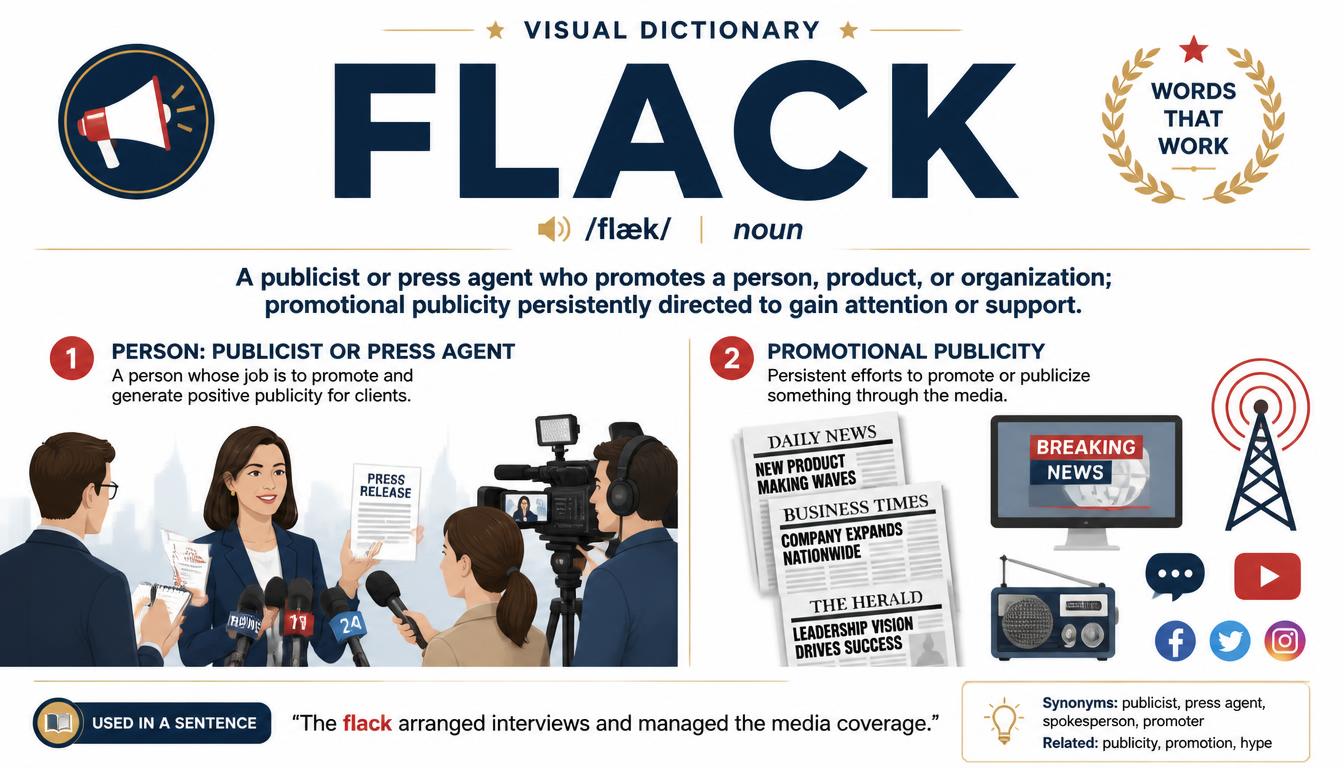

Have you ever read a sentence like “The company took a lot of flack after the announcement” and wondered what flack actually means? It is one of those little English words that can quietly change shape depending on the sentence, which is kinda confusing at first.
The word flack is commonly used for a press agent, publicist, or public relations professional, but it can also appear in expressions such as “take flack,” where it means to receive criticism or opposition. So, yes, one short word is doing more than one job.
If you are searching for flack meaning, flack definition, or what does flack mean, this guide explains the word in plain English. We will look at its noun and verb forms, examples, related expressions, and the very important difference between flack and flak.
Flack Meaning in Simple English
The most common flack meaning is a person who works to generate publicity or promote a person, company, product, organization, or event. In simple words, a flack can be a press agent, publicist, or PR professional.
For example, a movie studio might have a flack who contacts journalists, arranges interviews, sends out announcements, and tries to create positive media coverage for a new film. It sounds like a lot of talking, emailing, organizing and smiling at the right moment, honestly.
Flack can also be used as a verb. To flack means to work as a press agent or to engage in publicity and promotional activity. The verb is less common than the noun, but it does appear in journalism and informal writing.
There is another meaning that often causes confusion. In the phrase “take flack,” the word refers to criticism, opposition, or negative public reaction. So the person taking flack is not necessarily a publicist at all; they may simply be receiving criticism for something they said or did.
What Does Flack Mean as a Noun?
As a noun, flack usually refers to a person involved in publicity or public relations. The person may represent a celebrity, business, politician, movie, product, organization, or another public figure.
A traditional press agent tries to get attention for a client. Modern publicists may have a much broader role because they can handle social media, journalists, interviews, promotional campaigns, reputation management, and other forms of media relations.
Here are a few simple examples:
- The actor’s flack arranged several interviews before the movie premiere.
- The company hired a publicity agent to improve its public image.
- Her PR agent contacted reporters about the new product.
- The singer’s publicist responded to questions from the media.
- The movie’s press representative organized a promotional event.
In these sentences, flack basically points toward somebody whose work involves getting attention and shaping public perception. The exact job title may be publicist, press agent, PR representative, or communications professional depending on the workplace.
Flack Meaning in Public Relations
In the world of public relations, a flack is generally someone who promotes or represents another person, brand, organization, or project. Their work can involve communicating with journalists and helping their client receive favorable attention.
Imagine a new movie is coming out. Before the premiere, the studio may need interviews, press releases, reviews, celebrity appearances, photographs, and television coverage. A movie publicist may coordinate much of that publicity work.
The same idea can apply outside entertainment. A company launching a product may use a PR professional to create awareness, contact media outlets, prepare statements, and support a publicity campaign.
The word can sometimes sound slightly dismissive or negative, however. Calling someone a “flack” can suggest that the person is mainly trying to sell an idea or defend a client rather than offering completely neutral information. Language has these tiny attitudes hiding inside it, which is why context matters.
Flack as a Press Agent or Publicist
One of the easiest ways to understand flack meaning is to connect it with the word publicist.
A publicist promotes people, products, services, organizations, or events. A flack can perform essentially this kind of promotional work, especially when dealing with the press or other media.
For example:
- A celebrity may have a flack who handles media inquiries.
- A film may have several publicity professionals working on its release.
- A technology company may employ a PR representative for product promotion.
- A politician may have communications staff dealing with journalists.
- A brand may use a publicity agency to gain press coverage.
The work is not exactly the same as ordinary advertising. Advertising usually involves paid promotional space, while public relations often focuses on earned media, reputation, relationships, announcements, and public communication.
Flack Meaning as a Verb
Although flack is most familiar as a noun, it can also function as a verb.
To flack means to act as a press agent, provide publicity, or promote someone or something. It is generally an informal usage, so it may appear more often in journalism, commentary, or conversational writing than in formal business documents.
The related forms include flacks, flacked, and flacking.
For example:
- She flacks for several entertainment companies.
- He flacked for the author during the book launch.
- The agency is flacking for a new technology brand.
- They hired someone to flack the upcoming documentary.
In everyday English, though, people are more likely to say “work in PR,” “handle publicity,” or “act as a publicist.” The verb flack has a somewhat informal flavor to it, so it should be used with a little awareness.
What Does “Take Flack” Mean?
This is where the word becomes especially interesting.
To take flack means to receive criticism, opposition, complaints, or negative reactions. If someone “takes flack for” something, people are criticizing them because of that action, statement, decision, or opinion.
For example:
- The company took flack for raising its prices.
- The politician took flack for the controversial decision.
- The actor received flack from critics after the interview.
- The brand got flack from customers over the delayed launch.
- She took a lot of flack for her unusual opinion.
Here, flack meaning criticism is completely different from the publicist meaning. You are not talking about a PR worker. You are talking about negative feedback.
This expression is very common because public figures, businesses, writers, celebrities, and organizations often face criticism. Sometimes the criticism is serious, sometimes it is just people complaining loudly online, which can be its own strange little universe.
What Does “Take Flack For” Mean?
The phrase “take flack for” means to be criticized because of something.
The structure is usually:
person or organization + takes flack + for + reason
For example:
- The company took flack for changing its policy.
- The singer took flack for canceling the concert.
- The newspaper took flack for its headline.
- The manager took flack for the unpopular decision.
- The restaurant took flack from customers for poor service.
You can also use took flack, taking flack, get flack, getting flack, or receive flack, depending on the tense and sentence structure.
The phrase is informal but widely understandable. It often appears in news writing, entertainment coverage, opinion pieces, and casual conversation.
Flack vs Flak: What Is the Difference?
The biggest spelling confusion surrounding this word is flack vs flak.
Although the two words look almost identical, they have different histories and meanings. In modern informal English, flack can mean a publicist or criticism, while flak has a separate historical meaning connected with antiaircraft fire.
Flak originally referred to antiaircraft guns and the explosive shells fired at aircraft. The term is associated with a German military acronym from the period when antiaircraft artillery was widely discussed in relation to aerial warfare.
Over time, flak also developed a figurative meaning involving heavy criticism or opposition.
That means you may encounter both:
- take flack
- take flak
In contemporary writing, take flak is often used to mean receive criticism, while flak is the traditional spelling for the military term and is also commonly used for figurative criticism.
The spellings overlap in real-world usage, so readers may encounter both forms. It is one of those English situations where history, pronunciation, and popular usage decided to make things a little messier.
Is Flack the Same as Flak?
Not exactly.
When flack refers to a press agent, it is clearly different from flak, which has a military origin and can refer figuratively to criticism.
However, when flack is used to mean criticism, the distinction becomes less obvious because flak also has the figurative meaning of criticism.
Consider these examples:
- “The celebrity’s flack arranged the interview.” — a publicist.
- “The celebrity took flak after the interview.” — criticism.
- “The celebrity took flack after the interview.” — criticism, using the alternative spelling.
So context is your friend here. If the sentence is about a publicist, flack is being used as a person-related noun. If it describes criticism, you need to examine the surrounding words.
Flack Meaning in Journalism
The word flack has a natural connection with journalism because journalists regularly interact with publicists, press agents, and PR representatives.
A reporter may receive a press release from a company’s communications team. A celebrity’s publicist may offer an interview. A movie publicist may distribute promotional information before a film’s release.
In these situations, a flack can act as a bridge between a client and the media.
However, the word can carry a slightly negative tone in some contexts. Calling somebody a “public relations professional” sounds neutral and professional, while calling that same person a “flack” may suggest skepticism about their promotional role. Tiny wording choices can change the temperature of a sentence, and English loves doing that.
Flack Meaning in Entertainment
Entertainment is one area where the word flack may appear naturally.
Actors, musicians, directors, television personalities, and movie studios often work with publicists. These professionals can organize interviews, coordinate press appearances, distribute information, and help manage the public image of their clients.
For example:
- The actor’s flack released a statement to the press.
- The movie’s publicity team arranged interviews.
- The singer’s publicist contacted entertainment reporters.
- The studio’s PR representative coordinated the promotional campaign.
In celebrity journalism, the term can sometimes be used humorously or critically, especially when a publicist appears to be carefully controlling the message being presented to the public.
Flack Meaning in a Sentence
Seeing flack in a sentence makes the two major meanings much easier to recognize.
Here are useful examples:
- The actress hired a new flack before the film’s release.
- His publicist worked closely with entertainment reporters.
- The company hired a PR flack to handle media questions.
- The product received a lot of publicity from its promotional team.
- The politician took flack for the controversial statement.
- The restaurant got flack from customers after changing its menu.
- The CEO received flack for the company’s decision.
- The brand was taking flack on social media.
- She flacked for several performers during her career.
- The agency was flacking for a major entertainment client.
Notice how the surrounding words reveal which meaning is intended. A sentence mentioning reporters, publicity, or a client probably points toward the press-agent meaning. A sentence mentioning criticism or complaints points toward the criticism meaning.
Examples of “Get Flack” and “Receive Flack”
The expressions get flack, receive flack, and take flack all communicate roughly the same basic idea: someone is receiving criticism or opposition.
For example:
- The company got flack for its customer service.
- The author received flack from readers.
- The politician took flack for the proposal.
- The celebrity got a lot of flack online.
- The director received flack from critics.
- The organization took flack from customers.
The expression can describe criticism from almost anyone: customers, readers, fans, critics, employees, journalists, or the general public.
It does not necessarily mean the criticism is justified. Someone can take flack even when they believe they did nothing wrong. That distinction matters because receiving criticism and deserving criticism are obviously not the same thing.
Flack Meaning and Public Criticism
The criticism sense of flack is especially useful when describing public reaction.
Imagine a company announces a decision that customers dislike. News articles may say the company “took flack” or “came under fire.” A celebrity may receive criticism after making a controversial comment. A writer may get flack from readers because of an unpopular opinion.
In each case, flack describes the negative response rather than the actual mistake.
This is why the expression feels slightly more flexible than simply saying “criticism.” It often suggests criticism arriving from multiple directions, sometimes loudly and publicly.
The Origin of the Word Flack
The etymology of flack is not as straightforward as some English words.
The publicist sense has been associated with the name Gene Flack, a movie publicist active in the early twentieth century, although the exact history and development of the term have been discussed by dictionaries and language researchers. Some theories have also connected the word with Yiddish, but the precise origin is not considered completely settled.
The word’s history is therefore a good reminder that dictionary definitions and etymology are not always neat little family trees. Sometimes a word survives, changes meaning, picks up associations, and leaves researchers with a few unanswered questions.
The military word flak, meanwhile, has a much clearer connection with German military terminology and antiaircraft artillery.
Because the spellings became associated in popular usage, modern readers sometimes treat flack and flak as interchangeable in the criticism sense. That is why you may see both spellings in contemporary English.
Flack, Flak, and Context
When deciding whether flack or flak is appropriate, look at the meaning first.
If you mean a publicist or press agent, use flack.
If you are talking about antiaircraft fire, use flak.
If you mean criticism or opposition, both spellings can appear, although flak is traditionally associated with this figurative sense.
A few comparisons make this clearer:
- Flack: a person who handles publicity.
- Flack: criticism, in some informal usage.
- Flak: antiaircraft fire.
- Flak: criticism or opposition, figuratively.
English doesn’t always give us the luxury of one spelling for one meaning, sadly. Sometimes context has to do the heavy lifting.
Read more: https://ytmeaning.com/voila/
How to Use Flack Naturally
If you want to use flack naturally, pay attention to the tone of your sentence.
For the publicity meaning, words such as publicist, press agent, PR professional, public relations representative, and publicity agent can often be substituted depending on context.
For the criticism meaning, expressions such as take flack, get flack, and receive flack are the most natural.
For example:
- “The singer’s flack contacted the newspaper.”
- “The company took flack for the price increase.”
- “The movie’s publicist organized the interviews.”
- “The CEO received flack from customers.”
Trying to use the word in every possible sentence can make writing feel forced. It works best when the context naturally calls for it.
Related Forms of Flack
The word can appear in several grammatical forms.
Flack is the basic noun or verb.
Flacks can be the plural noun or third-person singular verb.
Flacked is the past-tense form when used as a verb.
Flacking is the present participle or gerund form.
You may also encounter flackery, a less common noun referring to promotional or public-relations activity, particularly when the writer wants to sound somewhat critical.
For example:
- Several flacks attended the event.
- She flacked for the company during its launch.
- They are flacking for a new entertainment project.
- The article criticized the industry’s flackery.
These forms are understandable, but some are much less common than ordinary terms such as publicist or publicity.
A Quick Guide to Flack Meaning
If you only need the essential answer, remember these points:
- Flack can mean a press agent or publicist.
- It can describe someone involved in public relations and publicity.
- To flack means to engage in publicity or promotional work.
- Take flack means to receive criticism or opposition.
- Get flack and receive flack have a similar criticism-related meaning.
- Flak traditionally refers to antiaircraft fire and can also mean criticism.
- Context tells you which meaning of flack is intended.
That small collection covers most everyday uses of the word without turning the definition into a dictionary maze.
Frequently aSked questions
flack meaning
Flack usually means a press agent or publicist who works to create publicity for a person, company, product, or organization. It can also mean criticism in expressions such as “take flack.”
flack def
Flack is a noun meaning a publicist, press agent, or public relations representative. In informal usage, it can also refer to criticism or opposition.
flack
Flack is someone who promotes or represents a person, brand, organization, or product through publicity and public relations. The word can also be used to describe criticism.
what is a flack
A flack is a person who works as a press agent or publicist, helping someone or something gain media attention and positive publicity. In another usage, “flack” means criticism or negative reaction.
Final Thoughts on Flack Meaning
The interesting thing about flack is how much meaning can sit inside four letters. It can point toward a press agent, a publicist, or someone working in public relations. It can also appear in the expression take flack, where the meaning shifts toward criticism and opposition.
If you encounter flack in a sentence, don’t immediately assume it has only one definition. Look around it. Words such as publicity, media, promotion, press, and public relations usually signal the professional meaning, while words such as criticism, customers, critics, complaints, and controversy usually point toward the negative-reaction meaning.
And when you see flack vs flak, remember that the distinction is largely about meaning and history, though modern English sometimes allows the spellings to overlap when talking about criticism.
Ultimately, what does flack mean depends on the sentence. It may be the person promoting the story, or it may describe the criticism arriving after the story. A tiny word, two very different directions — English really does enjoy keeping a few surprises in its pockets.
Tighten repeated sections and examplesClarify flack versus flak usage