
You finish arranging a dinner table, take one tiny step backward, and smile at the result: “Voilà!” Or maybe somebody fixes a stubborn computer problem, clicks one button, and says, “And voilà, it works.” The word arrives almost like a small verbal curtain being pulled away. Something is ready, revealed, solved, or suddenly worth noticing.
That lively feeling is at the heart of voila meaning. The word voilà comes from the French language, yet it has become comfortable enough in the English language that you’ll hear it in conversations, films, cooking demonstrations, social posts, and plenty of everyday moments. It can call attention to something, announce a result, or express satisfaction with what has just happened.
Still, this tiny word causes a surprising amount of confusion. Is it voila, voilà, viola, wallah, or wah-lah? Is the pronunciation “voy-la” or vwah-LAH? And does it really mean “there it is,” or is there more hiding inside those six little letters?
Here’s the lovely part: once you understand the definition, pronunciation, spelling, and history, voilà becomes ridiculously easy to use. So, a little linguistic curtain-raise and well, voilà.
What Does Voila Mean?
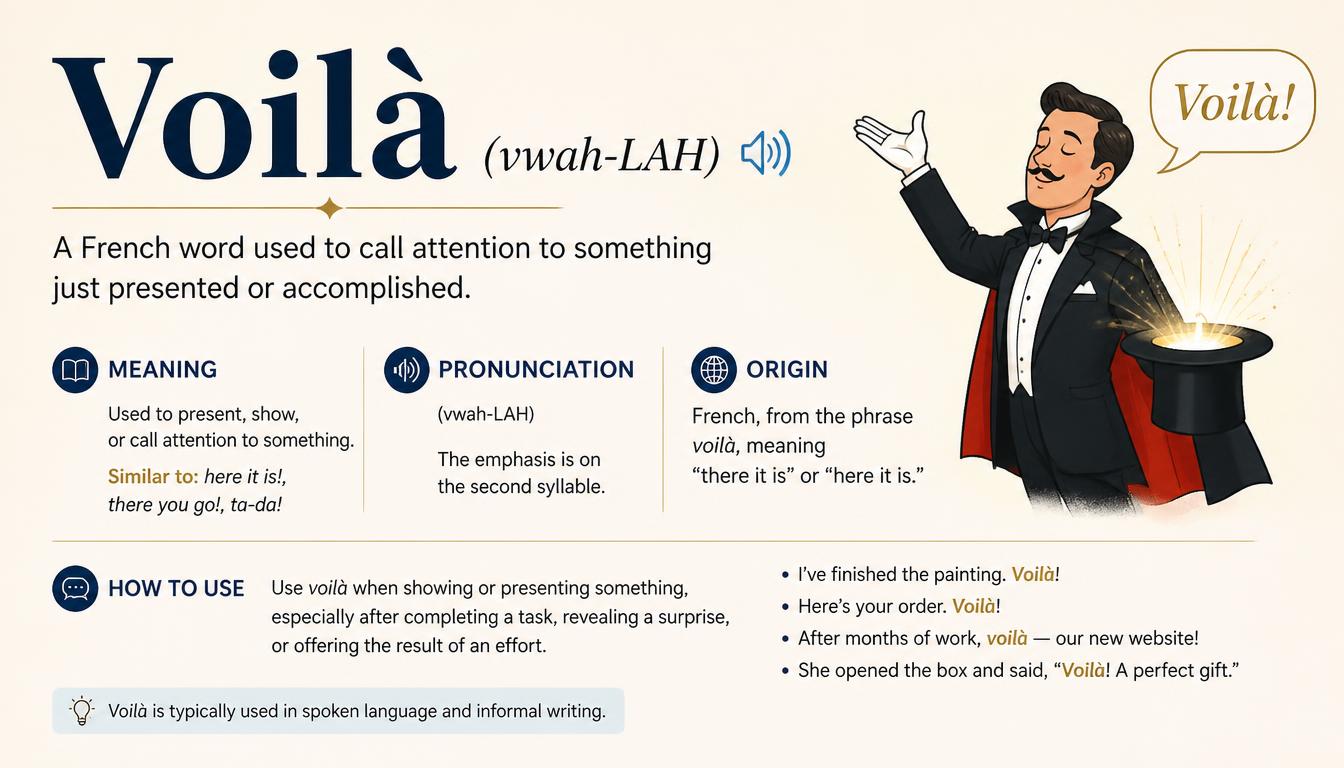
The simplest voila definition is “there it is,” “there you are,” or an expression used to draw attention to a result, person, or thing. As an interjection, voilà often announces that something has appeared, been completed, or is now ready to see.
In English conversation, it may communicate satisfaction, approval, surprise, or simple presentation. Its exact shade of meaning depends on the context, which is why a single translation doesn’t always catch its personality.
Consider these examples:
- “Add a little cream, stir for two minutes, and voilà dinner is ready.”
- “I moved the lamp beside the sofa and voilà, the room feels completely different.”
- “Click the green button and voilà, your document appears.”
- “She opened the gift box and, voilà, there was the necklace.”
- “A little paint, two new cushions, and voilà the old room looked fresh again.”
- “He entered the password correctly and voilà, the account opened.”
- “We added your name to the card and voilà, the birthday gift was complete.”
- “Fold the paper along this edge, open it gently, and voilà a little flower.”
- “The clouds moved aside and voilà, the moon appeared.”
- “She sprinkled some herbs over the pasta and said, ‘Voilà!’ with a grin.”
So, what does voila mean in ordinary English? Usually, it means something close to “there it is,” “there you have it,” or “look at that.” But its emotional flavour can range from quiet satisfaction to theatrical surprise.
Voilà Meaning in English
The voilà meaning in English changes slightly according to what is happening around the word. English speakers have borrowed it as a flexible exclamation, rather than treating it like a word with only one stiff dictionary equivalent.
You might use it when presenting something:
- “Here is the final design—voilà!”
- “I promised you homemade cake, and voilà!”
- “One finished wedding invitation, voilà.”
- “Your coffee, madam—voilà!”
- “The final photograph is ready, and voilà.”
- “Here’s the answer you were looking for—voilà.”
- “I found your missing key and voilà!”
- “The flowers are arranged. Voilà!”
- “Your new profile is live, voilà.”
- “And voilà, our little project is finally complete.”
You can also use it after explaining a simple process. In that situation, voilà carries a tiny spark of “and that’s all there is to it.” It makes the result sound pleasingly effortless, even if, truthfully, you spent forty minutes fighting with it first. Language can be cheeky like that.
The word can additionally suggest an appearance as if by magic. A magician revealing a rabbit could say “Voilà!” but so could somebody pulling the missing TV remote from beneath a cushion. One rabbit, one remote, same dramatic energy—sorta.
Voila Meaning: Attention, Satisfaction, and Surprise
Understanding voila meaning gets easier when you think about what the speaker wants you to notice. Voilà is rarely emotionally empty; it points your attention somewhere.
One common function is to call attention to an object or result. You have finished something and now want another person to look at it. “Voilà” acts almost like a tiny spotlight.
It can also express satisfaction:
- “I tightened the screw, and voilà the chair is steady again.”
- “A touch of lemon and voilà, much better.”
- “We finally finished the garden, voilà!”
- “I corrected the last mistake and voilà, all done.”
- “She changed one setting and voilà, the sound returned.”
- “A quick polish and voilà, it looks new.”
- “I shortened the sleeves and voilà, perfect fit.”
- “He restarted the router and voilà, internet again.”
- “We added fairy lights and voilà, instant atmosphere.”
- “Just one final brushstroke and voilà, finished.”
In other situations, the word communicates surprise or a sudden presentation. Something wasn’t visible before, and now—pop—it is. This is where that faint sense of magic sneaks into the expression.
What Is Voilà in French?
If you’re asking what is voilà originally, the answer takes us straight to French. Voilà is a French word and a familiar French expression used to point something out, present something, indicate a result, or direct someone’s attention.
Its historical construction is commonly explained through French elements associated with voir (“to see”) and là (“there”). This helps explain the traditional literal sense “see there.”
That literal idea is useful as a memory trick. Imagine someone gently pointing and saying, “See there!” Over time and through real conversation, however, French word voilà developed uses that are much more natural and flexible than a mechanical word-for-word translation suggests.
English borrowed the expression from French centuries ago. Merriam-Webster dates the first known use of voilà in English to 1739. That makes it far from some trendy internet expression; this little linguistic visitor has had plenty of time to unpack its suitcase.
As a borrowed French word, voilà kept much of its original dramatic flavour. English speakers didn’t merely borrow a definition—we kinda borrowed the gesture that comes with it too.
How to Pronounce Voilà Correctly
The voilà pronunciation is one of the biggest reasons people search for this word. Seeing it written down doesn’t necessarily tell an English speaker what should come out of their mouth.
A useful approximation of the French pronunciation is:
vwah-LAH
The second part receives noticeable emphasis, while the beginning sounds roughly like “vwah.” You may also see pronunciation guides such as vwa-lah or vwah-la, depending on how precisely the writer is representing the sound.
Try saying it smoothly rather than separating it into chunky syllables. “Vwah-LAH” should feel like one quick expression, not two words standing awkwardly at a bus stop.
Some practice examples:
- “And vwah-LAH, the cake is ready.”
- “Press here and voilà, it opens.”
- “One final adjustment—voilà!”
- “I found the problem and voilà, fixed.”
- “Mix everything together and voilà.”
- “Open the box and voilà, your surprise.”
- “A quick edit and voilà, finished.”
- “Turn the handle and voilà, you’re inside.”
- “Add the ribbon and voilà, perfect.”
- “Move this piece here and voilà, problem solved.”
English speakers naturally vary in accent, so an English pronunciation may not perfectly reproduce a native Francophonic pronunciation. That’s normal. The important thing is recognising that voilà begins with a “vw” type sound rather than being pronounced like “viola.”
How to Spell Voila: Voilà or Voila?
The traditional correct spelling is voilà, including the grave accent mark over the final a. That mark is part of the standard French spelling.
So, when asking how to spell voilà, remember:
Voilà = standard French spelling
Voila = common English typing without the accent
In written English, particularly informal writing, people frequently type voila because English keyboards don’t always make accents convenient. Readers will generally understand it, but voilà remains the more accurate form when you want to preserve the original French accent.
This gives us an easy little mnemonic: the accent falls on the final à, almost like a tiny arrow leaning toward the dramatic finish.
You’ll encounter both forms across online sources, casual messages, blogs, and sometimes edited sources. The absence of the accent doesn’t necessarily change the intended word meaning, though formal or careful writing generally benefits from using voilà.
Voila vs Voilà: Is There a Difference?
The voila vs voilà question looks bigger than it really is. Usually, both forms are intended to represent the same expression.
Voilà is the standard French form with its proper accent, while voila is widely used when someone cannot or doesn’t bother to type the accented character.
Examples include:
- “Voilà! Your order is ready.”
- “Voila! Your order is ready.”
- “And voilà, the problem disappeared.”
- “And voila, the problem disappeared.”
- “Voilà, our final result.”
- “Voila, our final result.”
- “A little editing and voilà!”
- “A little editing and voila!”
- “Voilà—exactly what we needed.”
- “Voila—exactly what we needed.”
The meaning remains clear in these examples. Still, if you’re writing professionally, discussing the French language, or explaining the etymology of voilà, using the accent is the neater choice.
Voilà vs Viola, Wallah, Wa-Lah, and Wah-Lah
Now we reach the slightly messy cupboard of common misspellings. Because people often hear voilà before they see it, they may invent a pronunciation-based spelling such as wa-lah, wah-lah, or vwa lah.
Viola is especially common as a mix-up, but viola is a completely different word. A viola is a stringed musical instrument. So, if you write, “I added some parsley and viola!” you’ve accidentally invited an orchestra into dinner.
Likewise, wallah is not the standard spelling of the French expression. It exists as a separate word in South Asian English and related contexts, so treating it as a spelling of voilà creates unnecessary confusion.
Here are the distinctions worth remembering:
- Voilà — standard spelling of the French expression meaning roughly “there it is” or “there you have it.”
- Voila — widely understood spelling without the accent mark.
- Viola — a musical instrument and a different word entirely.
- Wa-la / wah-lah — nonstandard spelling based mainly on how somebody hears the word.
- Vwa-lah / vwah-la — pronunciation guides rather than standard spellings.
- Wallah — a separate word, not the French expression.
- Voilà! — natural when making an enthusiastic reveal.
- And voilà — common when announcing the result of a process.
- Voilà? — possible in context, but far less typical than the exclamatory form.
- Voilà with its accent — safest choice when accuracy matters.
The pronunciation mismatch between French spelling and English expectations explains most of these errors. Hear “vwah-LAH” without ever seeing voilà written, and wah lah doesn’t seem like such a wild guess, tbh.
How to Use Voilà in a Sentence
Because voilà functions as an interjection, it can stand alone or appear within a sentence. Its position depends on the rhythm and intention of what you’re saying.
For a reveal, it often stands alone:
- “Voilà! The finished portrait.”
- “Voilà! Your birthday surprise.”
- “Voilà! I found the missing photograph.”
- “Voilà! One perfectly wrapped present.”
- “Voilà! The final version.”
- “Voilà! Your repaired watch.”
- “Voilà! Fresh cookies.”
- “Voilà! The answer.”
- “Voilà! Your new haircut.”
- “Voilà! Everything is ready.”
For a completed process, it naturally follows the final action:
- “Save the file, refresh the page, and voilà, your changes appear.”
- “Mix the flour and water, bake it, and voilà—fresh bread.”
- “Add your photograph, write a caption, and voilà, the invitation is finished.”
- “Tie the ribbon around the box and voilà, you’re done.”
- “Change that setting and voilà, the screen returns to normal.”
- “Give the flowers some water and voilà, they perk up.”
- “Add a little cinnamon and voilà, the flavour wakes up.”
- “Put the pieces together and voilà, a tiny paper boat.”
- “Upload the image and voilà, it’s live.”
- “Turn the key and voilà, the old cabinet opens.”
These voilà sentence examples show why the word feels so natural in tutorials, demonstrations, recipes, transformations, and reveals. It carries a pleasant little sense of completion.
When Should You Use the Voilà Expression?
The voilà expression meaning works especially well when a result deserves attention. It can make ordinary speech warmer, more playful, or slightly theatrical.
Imagine showing a friend the room you spent all weekend decorating. Saying, “It’s finished” is perfectly fine. Saying, “And voilà!” adds a small flourish, like throwing invisible confetti without making anyone clean it up.
You might use the expression when:
- Presenting something you’ve made.
- Revealing a gift or surprise.
- Showing the result of instructions.
- Celebrating a small problem being solved.
- Demonstrating a quick trick.
- Serving food or drinks.
- Showing a before-and-after transformation.
- Completing a creative project.
- Drawing attention to something unexpected.
- Expressing playful approval or satisfaction.
Because it can sound theatrical, context matters. In very formal academic or technical prose, another expression may be more appropriate. In conversation, tutorials, lifestyle writing, recipes, presentations, and informal usage, though, it fits beautifully.
Is Voilà an Interjection?
Yes. In English, voilà is commonly classified as an interjection. An interjection is a word or expression inserted into speech to communicate a reaction, feeling, command for attention, or sudden thought.
That grammatical role explains why voilà can happily exist on its own:
- “Voilà!”
- “And voilà!”
- “Ah, voilà!”
- “Well, voilà!”
- “Voilà, it’s ready.”
- “Voilà, there it is.”
- “And voilà, we’re finished.”
- “Voilà—the final answer.”
- “Voilà! Problem solved.”
- “Voilà, just as promised.”
As a French interjection borrowed into English, it hasn’t lost its expressive character. It does more emotional work than a plain phrase like “the task is complete.” There’s a wink in it, sometimes.
Voilà Origin and Etymology
The voilà origin tells a neat story about how languages borrow expressions that do a job particularly well. English has adopted countless words from French, and voilà is one of the more visibly French survivors.
The French etymology is traditionally connected with an imperative form related to voir, meaning “to see,” combined with là, meaning “there.” This historical structure gives the familiar literal explanation “see there.”
That doesn’t mean modern speakers mentally translate it into those words every time. Languages don’t behave like equations. A phrase develops personality through repeated usage, and voilà now performs several closely connected jobs.
Its documented first known use in English dates to 1739, according to Merriam-Webster. Across the centuries, the borrowed word became sufficiently established that English speakers could use it without suddenly switching the entire conversation into French.
That is perhaps what makes its word history charming: it crossed a linguistic border, kept its accent, and simply carried on talking.
Why Does Voilà Sometimes Feel Like “Magic”?
Watch a cooking show and you may hear someone place a finished dish on the counter and announce, “Voilà!” Watch a magic performance and the same word might accompany a sudden reveal.
That connection isn’t accidental in everyday usage. Voilà is wonderfully suited to a sudden appearance, especially when the speaker wants the result to feel effortless.
Picture these:
- “I pulled away the cloth and voilà—the painting.”
- “One tap and voilà, the lights came on.”
- “She opened her hand and voilà, the coin was gone.”
- “We moved the old furniture and voilà, twice the space.”
- “He opened the oven and voilà, golden bread.”
- “The curtain lifted and voilà, the entire stage appeared.”
- “A quick filter and voilà, a completely different photograph.”
- “She opened the tiny envelope and voilà, concert tickets.”
- “We wiped the dusty glass and voilà, a beautiful view.”
- “The magician snapped his fingers and voilà, flowers appeared.”
Of course, voilà doesn’t literally mean magic. It simply suits moments of revelation so nicely that the magical association has grown naturally around it.
Common Mistakes When Using Voilà
The biggest spelling mistake is writing viola when you mean voilà. Autocorrect may even encourage this because viola is a familiar English word. Check before publishing, especially in professional content.
Another common issue is overusing voilà. Because it has personality, repeating it every few sentences can make your writing sound like an overexcited cooking host who has discovered six cakes at once.
Watch for these mistakes:
- Writing viola instead of voilà.
- Assuming wah-lah is the correct spelling of voilà.
- Pronouncing every letter as though it were an English word.
- Forgetting the accent mark in formal discussion of French.
- Treating wallah as the same word.
- Translating it too literally in every context.
- Using it where no result, reveal, or point of attention exists.
- Repeating it excessively in formal prose.
- Assuming voila without an accent has a completely different meaning.
- Confusing a pronunciation guide with an actual spelling variant.
Remembering the basic trio—spelling and pronunciation, meaning, and context—prevents almost every problem.
What Does Voila Mean in Texting and Informal Writing?
In texting and informal writing, voila usually carries the same core meaning as voilà. People often omit the accent simply because typing it requires an extra step.
A friend might text:
- “Changed the password and voila, it works.”
- “Added two pillows and voila, new room lol.”
- “Found the receipt—voila!”
- “Restarted my phone and voila, fixed.”
- “Cut the photo smaller and voila.”
- “I added cheese and voila, dinner.”
- “Moved one setting and voila, problem gone.”
- “Found it behind the sofa, voila.”
- “Ten minutes of editing and voila.”
- “Put everything in one folder and voila, organised.”
The current usage is casual and flexible. Depending on tone, the word may sound proud, humorous, sarcastic, pleased, or playfully dramatic.
For example, “Three hours of work and voilà, something that looks like it took five minutes” uses the expression humorously. The underlying meaning remains a presentation of the final result, but the speaker is gently joking about the effort involved.
Voilà Meaning Made Easy to Remember
If all the definitions are starting to dance around your head, reduce voilà word meaning to one mental picture: someone pulls away a curtain and says, “There it is!”
That picture captures presentation, attention, surprise, and completion at once.
A second memory trick is:
Voir → see
Là → there
Voilà → roughly, “see there” / “there it is”
You don’t need to perform that translation every time you use the word. It is simply a handy way to remember the French origin and the general idea behind the expression.
For the pronunciation, remember vwah-LAH. For the spelling, remember the final French accent: voilà. And for usage, imagine revealing a finished result.
Three tiny reminders and—yes, you knew this was coming—voilà.
Frequently Asked Questions About Voila Meaning
What does voila mean?
Voila or voilà generally means “there it is,” “there you are,” or “there you have it.” It is commonly used to call attention to something that has been presented, completed, discovered, or revealed.
What is the correct spelling, voila or voilà?
The standard French spelling is voilà, with an accent mark over the final a. Voila is very common in English typing, particularly in casual digital communication.
How do you pronounce voilà?
A helpful English approximation is vwah-LAH. The exact sound varies somewhat between accents, but “viola” and “wallah” are not accurate standard pronunciations of the French expression.
What does voilà literally mean?
Its historical components are commonly explained as giving the sense “see there.” In natural modern usage, however, translations such as “there it is” or “there you have it” are usually more useful.
Is voilà French?
Yes. Voilà is French, and English later adopted it as a French borrowing. It has been recorded in English for centuries.
What is voila meaning in English?
The meaning of voila in English is usually “there it is,” “there you are,” or “there you have it.” Depending on the situation, it can also signal satisfaction, a reveal, or a surprising result.
Is “viola” another spelling of voilà?
No. In the voilà vs viola comparison, the two words are entirely different. Viola commonly refers to a musical instrument, while voilà is the French-derived expression.
Is “wah lah” the correct spelling?
No. Wa-la, wah-lah, and similar forms are usually attempts to spell the expression according to sound. The standard spelling is voilà.
Can voilà be used in formal writing?
It can, when its expressive tone suits the context. However, it is more common in conversation, descriptive prose, demonstrations, and relatively informal expression than in highly technical academic writing.
Why do people say voilà after finishing something?
The word naturally presents a completed result to an audience. Saying “and voilà!” essentially invites someone to look at what has just been created, fixed, discovered, or revealed.
voila meaning
Voila meaning is “there it is,” “there you have it,” or “look at this,” and it is commonly used to present or reveal something with a sense of satisfaction or surprise.
voila
Voilà is a French expression used in English to draw attention to something that has appeared, been completed, or is being presented.
what does voila mean
What does voila mean? It generally means “there it is” or “there you have it,” and it is often said when showing the result of an action or revealing something.
vuala expression
The vuala expression is a common phonetic spelling of voilà, a French expression meaning “there it is” or “there you have it.”
voula meaning
Voula meaning usually refers to voilà, which means “there it is” or “there you have it” and is used to introduce or reveal something.
Read more: https://ytmeaning.com/vendetta-meaning/
How to Use Voilà Naturally in Your Own Writing
The easiest way to use voilà naturally is to place it where you would otherwise say “there you have it,” “look,” or “and it’s done.” Don’t squeeze it into a sentence just because it sounds fancy; give it something to reveal.
For example, instead of writing, “The decoration is complete,” you could say, “Add the final ribbon and voilà—the decoration is complete.” Suddenly the sentence has movement. It lets the reader participate in the little reveal.
You can also adjust punctuation to fit the emotion. “Voilà!” feels enthusiastic and complete. “And voilà…” can feel softer or more playful. “Voilà the finished result” directs immediate attention toward whatever follows.
Most importantly, let the expression match your natural voice. A good borrowed word should add flavour, not sit on top of the sentence wearing a tiny French hat and demanding applause.
Conclusion: The Simple Meaning Behind Voilà
For such a short word, voilà carries a surprising amount of character. The basic voila meaning is “there it is,” “there you are,” or “there you have it,” but real-life usage gives it extra shades of attention, approval, satisfaction, surprise, and presentation.
The standard spelling is voilà, its pronunciation is approximately vwah-LAH, and its roots lie in the French language, where its history connects to the literal idea of “see there.” English borrowed the expression centuries ago, and it remains alive because sometimes “there it is” simply doesn’t have quite enough sparkle.
Use it when revealing a finished creation, solving a little problem, presenting something proudly, or pointing to a result that deserves its moment. Keep the accent when accuracy matters, avoid confusing it with viola or wallah, and let context decide how dramatic the expression should feel.
One French word understood, several confusing spellings untangled, pronunciation sorted, examples collected and voilà, you’re ready to use it.