

Have you ever received a bill and wondered why you were charged only part of the usual amount? Maybe you started a subscription halfway through the month, moved into an apartment on the 15th, or joined a company after the payroll period had already started. That strange-looking smaller charge is often described as prorated.
The simplest prorated meaning is this: an amount is divided and charged according to the portion of time, use, or entitlement involved. In other words, you don’t always pay the full amount when you have used only part of a service or period. It sounds a little formal, but the idea is actually pretty ordinary.
The word appears everywhere in everyday financial life, from rent and salaries to subscriptions, refunds, contracts, warranties, and fees. Once you understand it, a phrase such as “your first payment will be prorated” suddenly stops looking like accounting language from another planet.
What Does Prorated Mean?
So, what does prorated mean in plain English? It means an amount has been calculated proportionately rather than charging the entire amount.
If a service normally costs $100 for a full time period, but you use it for only half of that period, you might pay $50. That $50 is the prorated amount, assuming the calculation is based purely on time.
The important idea is proportion. Something is being divided, allocated amount by amount, or distributed proportionately according to a particular basis. Usually that basis is time, though it can sometimes be quantity, usage, ownership, or another agreed measurement.
For example, if your monthly gym membership costs $60 and you are entitled to only half a month, the company may calculate a prorated portion instead of asking for the entire $60. Pretty fair, right?
Prorated Definition in Simple Words
A practical prorated definition would be: an amount that has been assessed proportionately according to the relevant share, period, or usage.
Imagine a pizza divided into eight equal pieces. If someone is entitled to two pieces, they receive one-quarter of the whole pizza. A prorated payment works in a similar fashion, except the pizza has been replaced by money, time, services, or contractual benefits.
The word doesn’t necessarily mean “cheap” or “discounted.” A reduced amount is prorated only when the reduction comes from a proportional calculation. That tiny distinction matters more than it seems.
If a $120 annual fee is applied to only three months of service, the customer might owe $30. The $30 isn’t simply a discount; it represents the proportional amount corresponding to three months of a twelve-month period.
Prorate vs. Prorated: Understanding the Word Forms
The word prorate is a verb. It describes the action of dividing something proportionately.
For example, a company may prorate a subscription when a customer joins halfway through a billing cycle. The company is performing the calculation, basically doing the proportional math.
Prorated, meanwhile, is commonly used as an adjective and is also the past participle of “prorate.” You might see phrases such as “prorated rent,” “prorated salary,” or “prorated fee.”
There is also the noun-like idea of a prorater, meaning a person, system, or entity that performs or applies the proportional calculation. It isn’t nearly as common in everyday conversation, though, so don’t be surprised if you rarely hear it.
The pronunciation is generally understood as “pro-RAY-ted,” while “prorate” is pronounced “pro-RAYT.” English does enjoy making simple things look slightly fancier than they need to be.
How a Prorated Amount Works
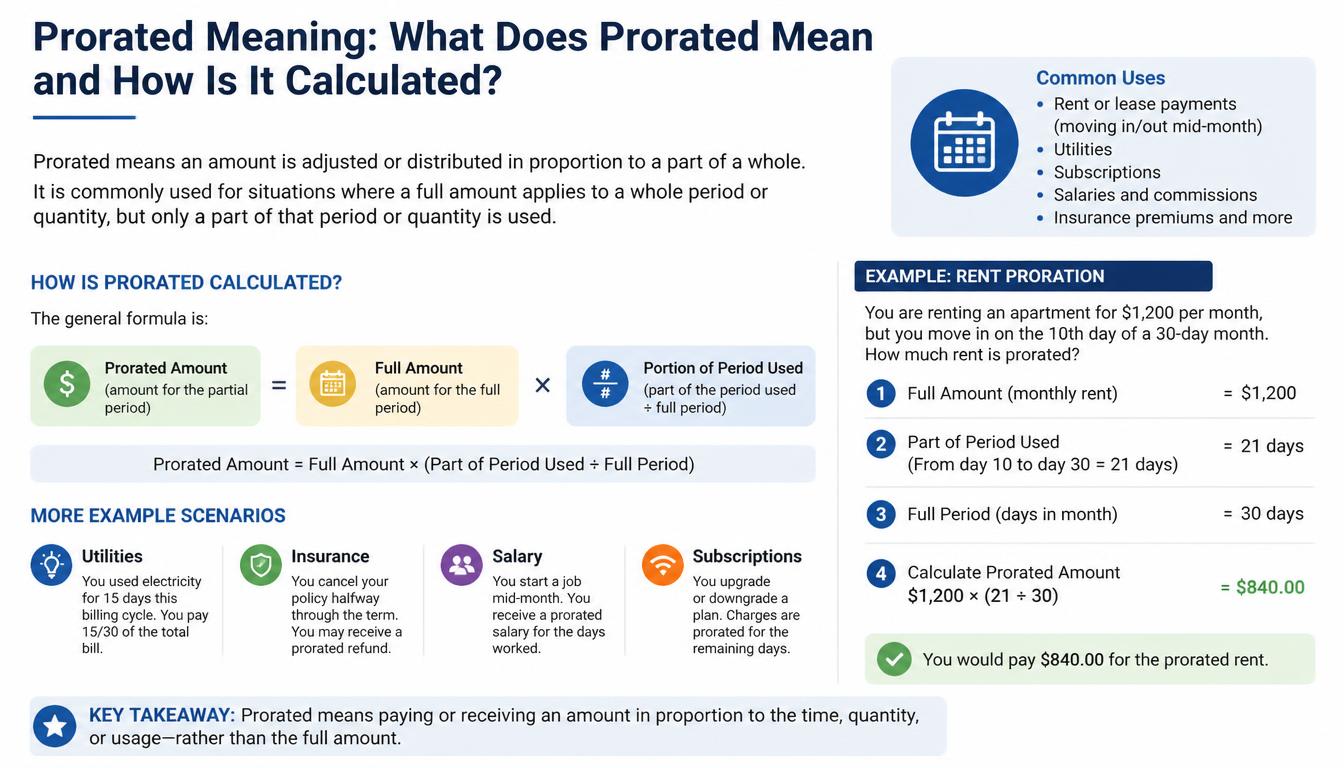
A prorated amount usually depends on three things: the full amount, the relevant period, and the portion of that period that applies.
A simple formula is:
Prorated amount = Full amount × (Applicable portion ÷ Full period)
Suppose an apartment costs $1,500 per month and the billing period is treated as 30 days. If someone moves in for 10 days, a simple daily calculation would be:
$1,500 ÷ 30 = $50 per day
Then:
$50 × 10 = $500
So the prorated rent would be $500 under that particular method.
Real agreements can use different conventions, such as the actual number of days in a month, so the exact figure may vary. Always check the relevant contract or billing terms, because mathematics can be simple while contracts, well, sometimes aren’t.
What Is Prorated When Time Is Involved?
Time is probably the most common basis for prorating. When someone uses a service for only part of a time period, the cost may be adjusted to match the amount of time involved.
There is an important difference between a full time period and a partial time period. If you use something for the whole period, you may owe the full charge. If you use it for only part of the period, the provider may calculate a partial amount.
This is often called a partial-period calculation or time-based allocation. The calculation tries to connect the amount owed with the actual duration involved.
For example, a monthly software subscription might begin on October 20 instead of October 1. Rather than charging the customer for all of October, the company could bill only for the days from October 20 through the end of the billing cycle.
Prorated Cost and Prorated Payment
A prorated cost is the portion of a normal cost assigned to a particular period, quantity, or entitlement.
A prorated payment, on the other hand, is the actual payment made for that portion. The two terms often appear together, although they’re not exactly identical.
Imagine a service costs $90 for 30 days. If you are responsible for 12 days, the daily rate is $3. Your prorated payment would therefore be $36 under a simple daily calculation.
This same logic can appear on an invoice as an adjusted payment, a partial charge, or another billing adjustment. The terminology changes, but the underlying idea stays wonderfully boring and consistent: pay for the share that applies.
Prorated Rent: A Common Everyday Example
Rent is one of the clearest examples of prorating because tenants often begin or end a lease somewhere in the middle of a month.
Suppose monthly rent is $1,800, but your lease begins on the 16th. If the landlord uses a 30-day calculation, the daily rate would be $60. For 15 days, the prorated rent would be $900.
But landlords don’t all use the same method. Some agreements calculate rent based on actual calendar days, while others use a fixed 30-day or another agreed method.
That’s why the prorated amount calculation should always be checked against the lease. A calculator can do the multiplication, but it can’t read the fine print for you. Not yet, anyway.
Prorated Salary and Payroll
A salary can also be prorated when an employee works for only part of a payroll period.
For instance, imagine an employee has a monthly salary of $3,000 but starts work halfway through the month. The employer may calculate the salary according to the number of eligible working days or calendar days, depending on company policy and applicable rules.
This creates a partial payment rather than paying the employee the full monthly salary.
The same principle can apply when an employee leaves before the end of a pay period, although payroll calculations can include taxes, deductions, unpaid leave, bonuses, and other details. So the basic prorated salary idea is simple, but the final paycheck may have a few more moving parts.
Prorated Subscription and Billing
Subscription services use prorating in several different ways.
Suppose a streaming platform charges $20 per month. You upgrade from a basic plan to a premium plan halfway through the billing cycle. The provider might calculate the extra cost for only the remaining days.
This is often called prorated billing.
The same concept appears with software subscriptions, internet services, memberships, cloud services, and other recurring products. A customer may see a prorated charge when changing plans, starting service, canceling service, or moving between billing levels.
Not every company prorates every change, though. Some providers deliberately wait until the next billing cycle, while others apply credits or immediate adjustments.
Prorated Fee, Price, and Charge
A prorated fee is a fee adjusted to reflect only the applicable portion.
A prorated price works similarly, especially when a product or service is available for only part of an agreed period. A prorated charge may appear when billing circumstances change during a cycle.
For example, a yearly membership might cost $240. If the provider agrees to charge for only three months, a simple proportional calculation would produce $60.
Again, that doesn’t mean every business must use this exact formula. The contract, billing policy, or agreement determines what calculation is actually appropriate.
Prorated Refund: Getting Money Back Proportionately
Prorating isn’t only about charging people more or less. It can also determine a prorated refund.
Suppose someone paid $120 for a 12-month service but becomes eligible for a refund after using six months. If the provider’s policy allows proportional refunds, the unused six months might represent $60.
That would be a proportional calculation based on unused time.
However, refund policies often contain conditions, cancellation rules, minimum commitments, or non-refundable fees. So don’t automatically assume that an unused portion always produces a refund. “Prorated” describes the method of calculation, not the existence of a refund.
Prorated Warranty and Declining Value
Warranties can also involve proportional calculations, especially when benefits change as a product ages.
A prorated warranty may provide decreasing coverage as the item gets older. This can involve a declining value, where the customer receives only part of the original warranty value or replacement cost.
For example, imagine a product originally valued at $500. A warranty agreement might establish different coverage levels depending on how long the product has been used.
The exact arrangement varies significantly between warranties, so the warranty document matters more than a generic formula. In this situation, the prorated value is connected to age, coverage, and the terms of the warranty.
Prorated Contracts and Financial Obligations
Contracts sometimes require amounts to be adjusted when circumstances change.
A prorated contract may specify how payment, benefits, fees, or obligations are calculated when a party enters or exits an agreement before the normal end date.
Imagine a contract with a $5 million annual obligation. If the agreement applies for only part of the contractual year and the contract explicitly requires proportional allocation, the applicable contract amount could be calculated according to the relevant period.
That doesn’t automatically mean $5 million should simply be divided by twelve. Contract language may establish another method, and legal or financial terms can change the calculation considerably.
Pro Rata Meaning and Its Connection to Prorated
The expression pro rata comes from Latin and generally conveys the idea of “in proportion.” It is closely related to the meaning of prorated.
When something is distributed proportionately, each party receives or pays a share based on an established proportion.
For example, if three people contribute different amounts toward a shared expense, a pro rata allocation could divide the cost according to their respective contributions.
So, pro rata meaning and prorated meaning overlap strongly, although “pro rata” can be used in broader contexts involving allocation, distribution, ownership, voting rights, expenses, and other proportional arrangements.
How to Calculate a Prorated Amount
To calculate prorated amount, first identify the normal or full amount.
Next, identify the full period or quantity to which that amount applies. Then determine the actual portion that should be charged.
A basic calculation looks like this:
Full amount × applicable fraction = prorated amount
For example, a $600 annual fee applies to 12 months. If only four months are applicable:
$600 × 4/12 = $200
The prorated amount is $200.
This is a simple example, of course. Real-world calculations may involve working days, calendar days, usage levels, percentages, minimum charges, taxes, or other adjustments.
Prorated Amount Meaning in a Bill
If you see “prorated amount” on a bill, it usually means the provider didn’t charge the ordinary full-period amount.
Maybe your service started late. Maybe you changed plans. Maybe you canceled early. Maybe your billing cycle changed. There are quite a few roads that lead to that little line on an invoice.
A prorated bill therefore contains an amount that has been adjusted based on the applicable portion of the service, period, or usage.
Checking the invoice dates and calculation details is the best way to understand why the figure appears. If the provider gives a daily rate, start date, end date, or percentage, those details usually reveal the calculation.
Synonyms and Antonyms of Prorated
There isn’t always one perfect synonym for prorated, because the best alternative depends on context.
Useful related terms include proportional, proportionate, allocated, adjusted, partial, distributed, and assessed proportionately.
For example, “a prorated fee” might also be described as an “adjusted fee” or “proportionate fee,” though the exact meaning can shift slightly.
Possible antonyms include “full,” “whole,” or “unadjusted” when the context is about receiving or paying the entire amount rather than only a proportion. Language loves context, unfortunately, so there isn’t always a neat one-word opposite.
Prorate Meaning in Grammar
From a grammar perspective, prorate is primarily a verb, while prorated is commonly used as an adjective or as the past participle form.
Examples include:
- “The company will prorate the fee.”
- “The customer received a prorated refund.”
- “Your first payment was prorated.”
- “The subscription uses prorated billing.”
The word can therefore move naturally between an action and the result of that action. That’s one reason you’ll see both “prorate” and “prorated” throughout financial and contractual writing.
Word History and First Known Use
The history of prorate is connected to the expression “pro rata,” which carries the idea of proportional division.
Dictionaries may provide historical details about the word’s development and its first known use. The year 1894 is commonly associated with the recorded use of “prorate” in English.
The connection to “pro rata” is useful because it makes the meaning easier to remember: something is being divided according to a proportion rather than treated as one indivisible full amount.
Common Situations Where You May See “Prorated”
The word can appear in many ordinary situations, including:
- Prorated rent when a tenant occupies part of a month.
- Prorated salary when an employee works part of a pay period.
- Prorated subscription when service begins or changes mid-cycle.
- Prorated fee when a charge applies only to part of an agreed period.
- Prorated refund when an unused portion is returned.
- Prorated warranty when coverage depends on product age.
- Prorated price when a product or service is used for only part of a period.
- Prorated charge when billing changes during a cycle.
- Prorated contract amount when an obligation covers only part of a contract period.
Seeing the same word across all these situations can make it seem complicated, but the central concept barely changes. Find the whole, identify the applicable share, and calculate that share.
Read articul: https://ytmeaning.com/ornery/
Common Mistakes About Prorated Amounts
One common misunderstanding is assuming that every reduced payment is automatically prorated. That’s not true.
A discount is a reduction based on pricing policy. A prorated amount is a reduction or adjustment based on a proportional calculation.
Another mistake is assuming every company uses the same number of days. One provider may use actual calendar days, while another may use a standardized billing period.
People also sometimes assume that prorating guarantees a refund. It doesn’t. Whether money is returned depends on the applicable agreement or policy.
How to Understand a Prorated Charge on Your Own Bill
When you encounter an unfamiliar prorated charge, start by finding the normal full price.
Then look for the billing dates. Determine how much of the contract period, subscription cycle, rental period, or other relevant duration actually applies.
After that, compare the charged amount with the expected proportion. If the numbers don’t make sense, ask the provider for the exact calculation rather than guessing.
A good billing explanation should make the calculation understandable. If someone tells you “it’s prorated” and stops there, you’re perfectly reasonable to ask, “Prorated based on what?” That’s the useful question.
Frequently asked Qeustions
Sure — I’ll keep your H3 headings exactly unchanged and provide a natural 1–2 line English answer for each.
prorated
Prorated means divided or calculated proportionately, usually based on the amount of time, use, or share involved.
pro rated
Pro rated means an amount has been adjusted according to a partial period rather than charging the full amount.
pro rated meaning
The meaning of pro rated is that something is calculated fairly according to the portion used, received, or owed.
pro-rated
Pro-rated describes a payment, cost, or amount that has been divided proportionately based on a specific period or share.
what is prorated mean
“Prorated” means an amount is reduced or adjusted to match the actual time or portion involved instead of using the full amount.
Add a practical example to every answerImprove the awkward question wording
Final Thoughts on Prorated Meaning
The easiest way to remember the prorated meaning is to think about fairness through proportion. When the full amount covers a full period or full entitlement, a prorated amount adjusts that figure when only part of it applies.
Whether you’re looking at prorated rent, prorated salary, prorated billing, a prorated payment, or a prorated refund, the basic principle remains remarkably steady: calculate the share that belongs to the relevant portion.
The word may sound like something designed exclusively for accountants and contracts, but it shows up in very normal life. A new subscription, a mid-month move, a changed service plan, or an early cancellation can all bring it onto your bill.
So the next time you see “prorated,” don’t let the formal-looking word scare you. Think proportion, partial period, adjusted amount. Once those three ideas click together, the whole thing becomes much less mysterious — and your next confusing invoice may suddenly look a little more human.
Fix awkward keyword phrasingRemove repetitive explanatory sections