
There are some foods that arrive quietly on a plate, and then there are foods that seem to announce themselves. The Cronut belongs to the second group. At first glance, it looks a little like a doughnut, but one bite reveals something much more layered, flaky, and buttery.
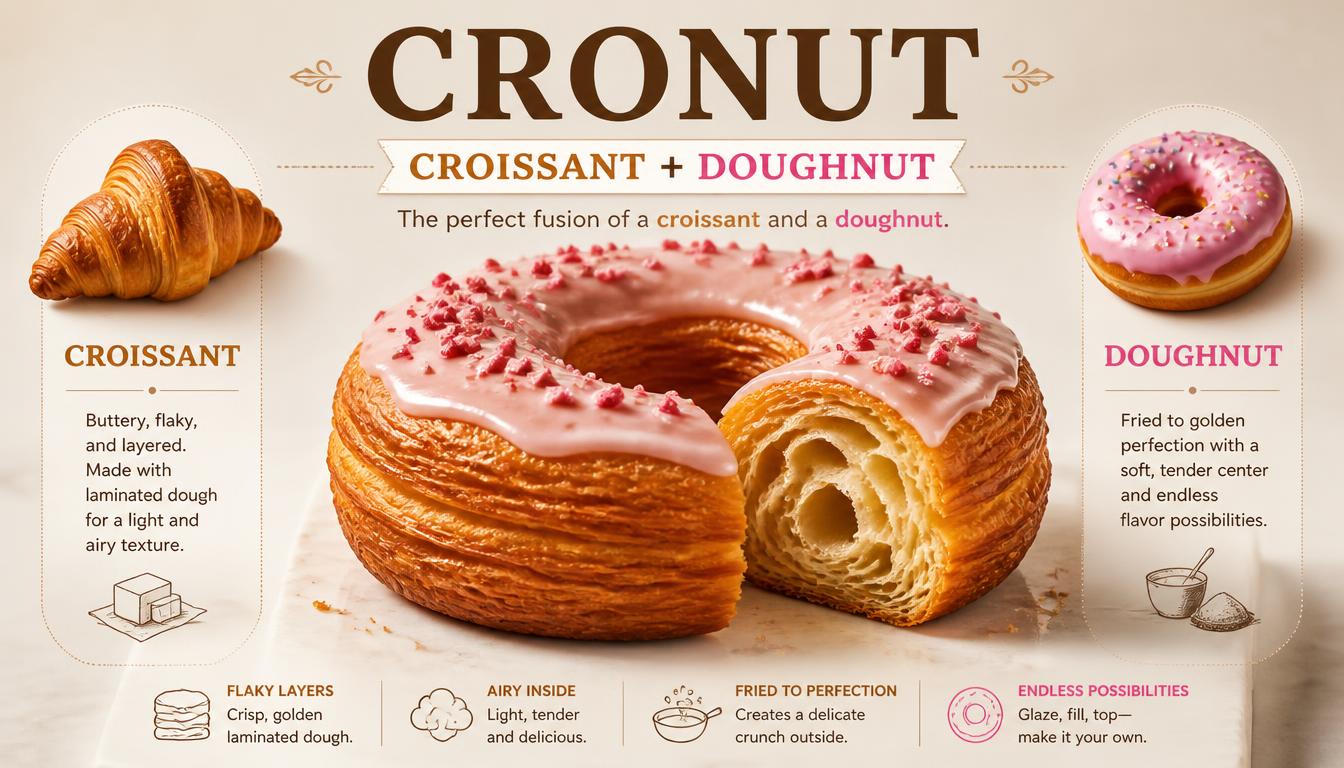
The simplest cronut meaning is a pastry that combines characteristics of a croissant and a doughnut. It is generally made from laminated croissant dough, shaped into a ring, and deep-fried rather than baked like a traditional croissant.
That combination sounds almost too obvious now, doesn’t it? Yet the idea became a major pastry trend, turning an unusual pastry hybrid into a widely recognized food name.
Cronut Meaning in Simple English
The cronut definition is fairly straightforward: a Cronut is a ring-shaped pastry made using laminated croissant-style dough and prepared through frying, giving it qualities associated with both a croissant and a doughnut.
So, when someone asks, “what is a Cronut?”, the easiest answer is: it is a croissant-doughnut hybrid.
Unlike an ordinary doughnut, which usually has a soft, bread-like or cake-like texture, a Cronut can have delicate, buttery layers inside. The outside may become crisp and caramelized during frying, while the interior retains the characteristic layered structure of flaky pastry.
The name itself is part of the fun. It sounds almost like somebody took “croissant” and “doughnut,” tossed the words into a linguistic blender, and decided the result sounded delicious.
What Does Cronut Mean as a Food Name?
When people search what does Cronut mean, they are usually looking for both the definition and the story behind the name.
“Cronut” is a trademarked name associated with a particular pastry creation. The word functions as a brand name as well as a description that became famous in popular food culture.
Its word formation reflects the relationship between croissant and doughnut. The name is commonly understood as a blend of “croissant” and “doughnut,” although the actual pastry has its own specific preparation and identity.
That distinction matters because not every fried croissant-style ring should automatically be treated as the original branded product. Food language gets messy like that, especially when a clever name becomes part of everyday vocabulary.
Cronut Meaning and the Croissant-Doughnut Connection
The heart of the cronut pastry is the connection between two familiar foods: the croissant and the doughnut.
A croissant contributes its laminated dough, buttery character, and multiple delicate layers. A doughnut contributes the familiar ring shape and fried preparation.
Put those ideas together and you get something that feels familiar but behaves differently when you eat it.
The result is neither simply a croissant nor simply a doughnut. It is a hybrid pastry with its own texture, appearance, and culinary identity.
That is also why describing it merely as a “fancy doughnut” misses half the story. The layered dough is important. So is the technique used to create it.
What Is a Cronut Made Of?
A typical Cronut begins with dough similar in structure to croissant dough. The dough is laminated, meaning butter is incorporated through repeated folding and rolling to create thin layers.
The exact ingredients can vary depending on the recipe or bakery, but common components may include flour, butter, yeast, milk or water, sugar, and salt.
After the dough has been prepared and layered, it is shaped into a ring. The pastry is then fried, which gives it a crisp exterior and a rich, cooked-butter flavor.
Many versions are finished with additional ingredients such as glaze, sugar, cream, custard, or flavored fillings.
So, if someone asks what is Cronut made of, the short answer is: laminated croissant dough, shaped like a doughnut and fried, often with a sweet filling or topping.
How Is a Cronut Made?
Making a Cronut is more involved than simply cutting a hole in croissant dough and putting it into hot oil.
First, a dough is prepared and allowed to develop its structure. Butter is then incorporated through lamination, creating the thin layers that give the pastry its distinctive texture.
The dough is rolled and folded several times. This process produces the characteristic layers associated with a layered pastry.
After resting and shaping, the dough is cut into rings. The shaped pieces are then fried at a controlled temperature.
Once cooked, the pastries may be drained and cooled before being filled, glazed, sugared, or decorated.
This is where the work of a skilled pastry chef becomes important. The dough needs to maintain its layers while also surviving the frying process. Too little control and the pastry can become greasy; too much frying and those delicate layers may lose their charm.
Cronut vs Doughnut: What Is the Difference?
The Cronut vs doughnut comparison is one of the easiest ways to understand the pastry.
A traditional doughnut is commonly made from yeast-raised or cake-style dough. Its texture can be soft, fluffy, cakey, or chewy depending on the recipe.
A Cronut, meanwhile, is built around laminated croissant-style dough.
The biggest difference is therefore not simply the shape. Both may be ring-shaped, but their internal structure is different.
A doughnut generally has a more uniform crumb, while a Cronut can contain numerous thin, buttery layers.
The frying process also gives both pastries some similarities. But once you tear one open, the difference becomes much more obvious. A regular doughnut says “bread-like pastry”; a Cronut tends to say “look at all these little layers I have.”
Cronut vs Croissant: Why Aren’t They the Same?
The Cronut vs croissant comparison is equally interesting because the Cronut begins with an idea closely related to the croissant.
A croissant is traditionally shaped into a crescent and baked. It is famous for its buttery aroma, crisp exterior, and layered interior.
A Cronut uses a similar laminated dough concept but changes the shape and cooking method.
Instead of becoming a crescent-shaped baked pastry, it becomes a ring-shaped pastry that is fried.
So while the two share an important dough-making tradition, they aren’t identical foods.
Think of the croissant as one branch of the pastry family tree and the Cronut as a rather adventurous cousin who decided that frying sounded like a good weekend plan.
Cronut Pronunciation: How Do You Say It?
The usual Cronut pronunciation is close to “kroh-nuht.”
In American English, dictionary-style pronunciation may be represented approximately as /ˈkroʊnət/.
If you’re wondering how to pronounce Cronut, say it naturally as two blended sounds: the beginning resembles “cro” from croissant, followed by a sound resembling “nut” from doughnut.
Because the word is a coined food name, pronunciation is generally easier than its spelling might suggest.
You don’t need to make it sound overly French or dramatically sophisticated. Just pronounce it naturally and move on to the important part: eating it.
Cronut Origin and Etymology
The Cronut origin is closely connected with the modern pastry scene in New York City.
The pastry was created by pastry chef Dominique Ansel and became famous after its introduction in 2013 at Dominique Ansel Bakery.
The Cronut etymology reflects the combination of the words “croissant” and “doughnut.” This type of word formation is known as a blend or portmanteau, where parts of two words are combined to create a new term.
The story is interesting because the name did not merely describe an ordinary pastry. It became associated with a specific culinary creation and developed a recognizable identity of its own.
That is why the origin of the word Cronut is inseparable from the origin story of the pastry itself.
Why Did the Cronut Become So Popular?
The Cronut appeared at exactly the right moment for modern food culture.
People were becoming increasingly interested in unusual combinations, visually interesting foods, specialty desserts, and creations that could be photographed and shared online.
The Cronut had several qualities that made it naturally attention-grabbing.
It looked familiar enough to understand immediately, but different enough to make people curious. It combined the buttery layers of a croissant with the fried character of a doughnut.
The result was a viral pastry before “viral food” had become such an ordinary phrase.
Queues, media coverage, social sharing, and curiosity helped transform the pastry from a bakery creation into a broader food trend.
The Cronut as a Modern Pastry Innovation
Food history is full of combinations that initially sound strange but eventually become normal.
The Cronut is a good example of culinary innovation through combination rather than invention from nothing.
It didn’t require the invention of an entirely new ingredient. Instead, it took familiar techniques and characteristics and rearranged them.
Croissant dough already existed. Doughnuts already existed. Fried pastries certainly weren’t new.
The innovation came from bringing those ideas together in a carefully developed pastry.
That is one reason the Cronut remains interesting beyond its original popularity. It demonstrates how pastry innovation can emerge from changing shape, technique, texture, and presentation.
What Does a Cronut Taste Like?
Taste depends heavily on the bakery, filling, glaze, and preparation, but a well-made Cronut can offer several sensations in one bite.
The outside may be crisp and lightly caramelized. Inside, the laminated dough can feel buttery and layered.
If filled with pastry cream or another sweet filling, the center adds a softer, richer contrast.
A glaze can bring additional sweetness, while toppings may introduce flavors such as chocolate, vanilla, fruit, coffee, or spices.
This combination makes the Cronut a sweet pastry rather than simply a fried piece of dough.
And yes, it can be rich. Very rich. The sort of rich where one bite politely reminds you that butter exists for a reason.
Is a Cronut a Doughnut or a Croissant?
Technically, it is better understood as its own pastry hybrid rather than simply choosing one side.
It has characteristics of a croissant because the dough is laminated and layered.
It resembles a doughnut because of its ring shape and frying method.
However, reducing it to either one misses what makes the pastry distinctive.
A useful way to remember the Cronut meaning is:
Cronut = croissant-style laminated dough + doughnut-like shape + frying + sweet pastry finishing.
That simple formula explains the basic idea without pretending the two original pastries are exactly the same.
Cronut Meaning in Everyday Conversation
People may use the word Cronut in conversations about desserts, bakeries, food trends, travel, or unusual foods.
For example, someone might say that they tried a Cronut while visiting New York, or that a bakery has introduced a new filled version.
The word can therefore function as a specific food reference rather than merely a generic description.
Some people may also use “cronut” loosely for pastries that imitate the concept. In careful usage, however, the original trademarked name has a more specific identity.
Understanding this distinction is especially useful when reading menus, food articles, or discussions about pastry history.
Why the Cronut Is Different From an Ordinary Fried Pastry
Many pastries are fried, so frying alone doesn’t explain what makes a Cronut special.
The important detail is the combination of laminated dough and frying.
Lamination creates alternating layers of dough and butter. When handled correctly, those layers create a flaky, delicate structure.
Frying then changes the exterior and adds another dimension of texture.
This produces a pastry that can be crisp, flaky, rich, chewy, and tender in different places.
That’s a lot of personality for something shaped like a ring.
Cronut as a Food Trend and Cultural Phenomenon
The rise of the Cronut also tells us something about how food becomes culturally important.
A popular pastry doesn’t always become famous because it is completely unfamiliar. Sometimes the opposite happens.
People recognize a croissant. They recognize a doughnut. Then somebody combines their most recognizable characteristics and creates a question in the reader’s mind: “Wait, what is that?”
Curiosity drives tasting. Tasting drives conversation. Conversation drives media attention.
In the age of social media, a visually distinctive dessert can travel remarkably quickly from a bakery counter to screens around the world.
The Cronut became a memorable example of that process.
How to Use the Word Cronut Correctly
If you’re writing about the pastry, “Cronut” should generally be treated as a specific name rather than an ordinary synonym for every croissant-doughnut combination.
You can use expressions such as Cronut pastry, Cronut dessert, or Cronut meaning when explaining the concept.
For a general description, phrases like “croissant-doughnut hybrid” or “fried laminated pastry” can explain the characteristics without relying on the trademarked name.
This is particularly useful for food writers, bloggers, students, and anyone researching English vocabulary or food terminology.
Common Questions About Cronut Meaning
What does Cronut mean?
Cronut refers to a distinctive pastry associated with a combination of croissant-style laminated dough and doughnut-like shape and preparation. The name is a trademarked term.
What is a Cronut?
A Cronut is a fried, ring-shaped pastry made using laminated dough similar to croissant dough. It is commonly finished with fillings, glazes, or sugar.
Is a Cronut a croissant?
Not exactly. A Cronut uses croissant-style laminated dough, but its shape and frying method make it different from a traditional baked croissant.
Is a Cronut a doughnut?
It resembles a doughnut and is fried, but its laminated, croissant-like dough gives it a distinctly different texture.
Why is it called a Cronut?
The name is commonly understood as a blend of “croissant” and “doughnut,” reflecting the pastry’s hybrid character.
How do you pronounce Cronut?
The common Cronut pronunciation is approximately “kroh-nuht,” with the first part resembling “cro” and the second sounding like “nut.”
Read more: https://ytmeaning.com/redundant-meaning/
Who created the Cronut?
The pastry was created by pastry chef Dominique Ansel and became widely known after its 2013 launch in New York City.
Is Cronut a trademark?
Yes. Cronut is a trademarked name associated with Dominique Ansel’s pastry creation, so the term has a more specific identity than a generic pastry description.
What is Cronut made of?
A Cronut is based on laminated pastry dough similar to croissant dough. Depending on the version, it may also include fillings, glaze, sugar, cream, or other toppings.
Why are Cronuts so popular?
Their popularity comes from the unusual combination of familiar pastry characteristics, distinctive texture, attractive appearance, and the broader food trend surrounding innovative desserts.
define cronut
A Cronut is a pastry made from laminated croissant-style dough that is shaped like a doughnut and fried. It combines features of both a croissant and a doughnut.
cronut meaning slang
“Cronut” is generally not a slang term; it refers to a specific pastry combining croissant dough with a doughnut-like shape and preparation.
cronut definition
A Cronut is a ring-shaped, fried pastry made from layered croissant dough, often filled or topped with cream, glaze, or sugar.
cronut meaning
Cronut means a croissant-doughnut hybrid, combining flaky laminated pastry with the shape and fried preparation associated with a doughnut.
cronuy
“Cronuy” is not the standard spelling of Cronut and does not have a commonly recognized English meaning; it may simply be a typing or spelling variation.
How to Remember the Cronut Meaning Easily
If complicated food definitions make your brain wander toward the nearest snack, use one simple memory trick.
Remember three words: croissant, doughnut, hybrid.
A Cronut takes the layered character associated with a croissant, the ring-shaped fried concept associated with a doughnut, and combines them into a distinctive modern pastry.
You don’t need a long dictionary paragraph to remember it.
Cronut = croissant-style pastry + doughnut-style shape and frying.
Once that connection sticks, the meaning becomes surprisingly easy.
Why the Cronut Still Matters in Pastry Culture
Food fashions come and go quickly. One dessert becomes famous, another takes its place, and yesterday’s trend becomes tomorrow’s bakery trivia.
Yet the Cronut remains an important example of how a pastry can become more than a recipe.
It represents culinary creativity, clever naming, modern food marketing, and the power of curiosity.
Its story also shows that innovation doesn’t always require something nobody has ever seen before. Sometimes it means looking at two familiar things and asking what happens if they meet in the middle.
That is essentially the Cronut’s whole personality.
Final Thoughts on Cronut Meaning
The cronut meaning is simple once its ingredients and history are understood: it is a distinctive pastry hybrid made from croissant-style laminated dough, shaped into a doughnut-like ring, and fried before often being filled or glazed.
Its name comes from the relationship between croissant and doughnut, while its identity grew from a specific pastry creation that became a worldwide food trend.
What makes the Cronut memorable isn’t merely its unusual name. It is the contrast of flaky layers, crisp fried edges, buttery richness, sweet fillings, and playful presentation.
So the next time somebody asks, “what does Cronut mean?”, you can give them the short answer: it is a croissant-inspired, doughnut-shaped fried pastry.
And perhaps the slightly better answer is this: sometimes the most memorable foods are born when two familiar ideas stop behaving themselves and decide to become something new.