Have you ever watched a movie and heard footsteps on a wooden floor, keys rattling in someone’s hand, or the soft crunch of snow beneath a character’s shoes? Those sounds may seem ordinary, but many of them are carefully created in a studio rather than captured during filming. This is where the word foley comes into the picture, and its meaning is more interesting than you might expect.
The foley meaning is closely connected to sound effects used in films, television shows, and other recorded media. It describes the art of creating and recording everyday sounds that make scenes feel realistic, emotional, and alive. Without these little details, even an expensive movie could feel strangely empty.
However, Foley has a particular history, a unique pronunciation, and even a separate meaning in medical terminology. Understanding the word helps you appreciate not only English vocabulary but also the creative work happening behind your favorite movies.
What Is the Foley Meaning?
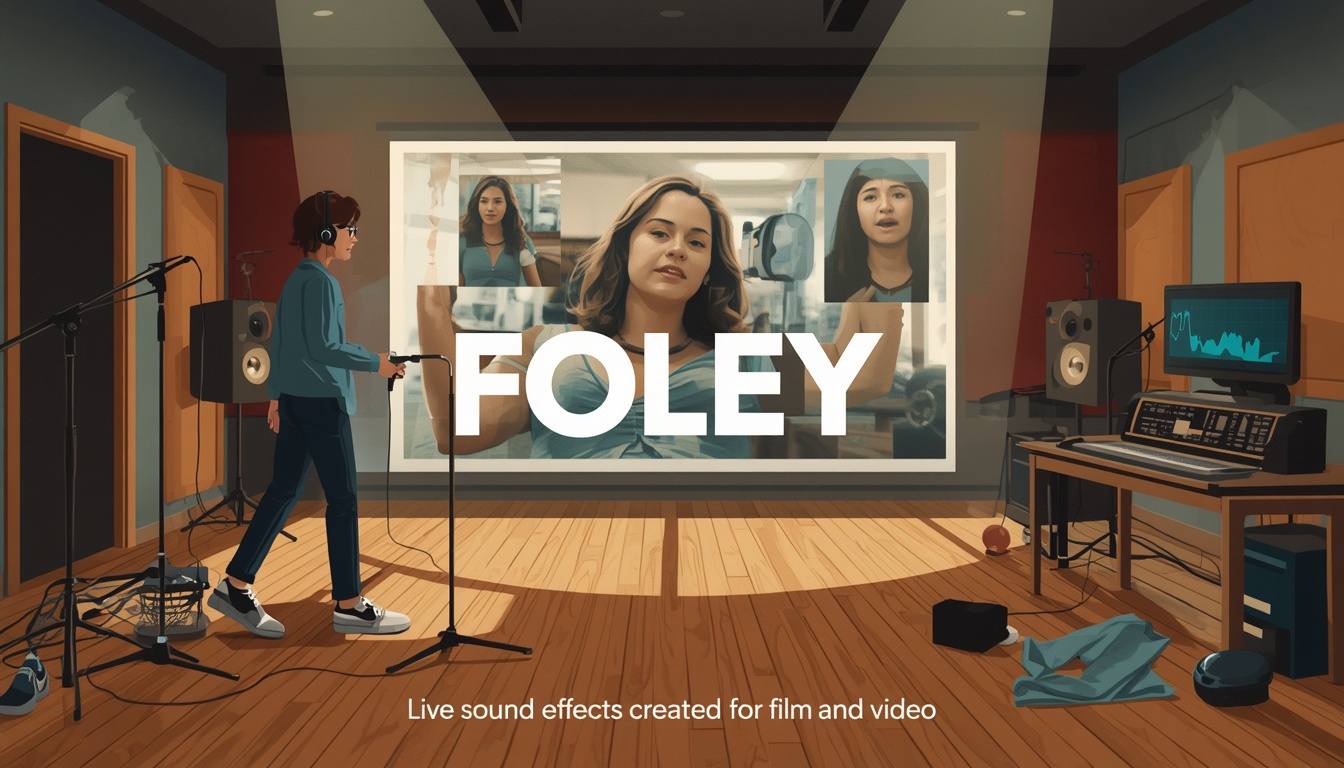
The word foley primarily refers to the reproduction of everyday sound effects for film, television, video games, and other audiovisual productions. These sounds are often recorded separately and synchronized with the action on screen.
For example, when a character walks across a room, a Foley artist may recreate the footsteps in a recording studio. The sound might be produced by walking on wood, concrete, gravel, or another surface that matches the scene.
The foley definition is therefore closely associated with practical sound creation and recording. It is not simply about making noise; it involves matching sounds to movements, objects, and the atmosphere of a scene.
Think about a suspenseful movie in which a character slowly opens a creaking door. That tiny sound can make the audience nervous before anything frightening actually happens. Foley gives ordinary actions this kind of presence.
What Does Foley Mean in Film?
When people ask, “What does foley mean in film?” they are usually referring to the process of creating realistic sounds that support the images on screen.
Film cameras capture pictures and some location audio, but they do not always record every sound clearly. Background noise, dialogue, equipment, and outdoor conditions can make certain sounds difficult to capture. Foley artists recreate those missing details during post-production.
Common examples of foley sound effects include:
- Footsteps on grass, pavement, wood, sand, or snow.
- Clothing rustling when an actor moves.
- Keys jingling, bags opening, and objects being picked up.
- Doors closing, chairs scraping, and furniture shifting.
- Paper crumpling, pages turning, and small items falling.
- Hand movements and physical contact during carefully staged scenes.
These sounds help viewers believe what they see. A character might be walking through a quiet hallway, but the soft tapping of shoes and the movement of clothing make the moment feel much more convincing.
That is the beauty of Foley: when it works well, most viewers never notice the work behind it.
What Is a Foley Artist?
A foley artist is a sound professional who recreates everyday noises to match the actions in a film, television program, or another production.
Instead of relying entirely on sounds recorded during filming, the artist performs movements and manipulates objects in a controlled studio environment. The resulting recordings are then synchronized with the visual action.
Imagine a scene in which a detective enters a dark room, places a glass on a table, and pulls a chair backward. The Foley artist might perform each action using suitable props and surfaces, recording the sounds one at a time.
A Foley artist needs more than good hearing. The job requires timing, creativity, attention to detail, knowledge of materials, and an understanding of how sound influences emotions.
Some artists can spend several minutes finding the right sound for a single movement. A heavy leather coat, for instance, makes a different noise from a thin cotton shirt, and that difference can matter when a scene is meant to feel authentic.
How Are Foley Sound Effects Created?
The process of creating Foley effects is a practical combination of performance, experimentation, and audio recording. It may look unusual from the outside, but every movement has a purpose.
Studying the Scene
First, the Foley team watches the footage carefully. They identify movements that need additional sound, including footsteps, hand gestures, object handling, and interactions with the environment.
The artist pays attention to timing, distance, speed, and the type of surface involved. A person running away in panic should sound different from someone walking slowly through a peaceful garden.
Choosing the Right Props
Next comes the search for suitable materials and objects. Artists use shoes, fabric, wooden boards, gravel, containers, and countless other items to create realistic noises.
Sometimes the perfect sound comes from an object that would never be used for its apparent purpose. A creative artist experiments with different materials until the recording fits the scene.
Recording the Sounds
During foley sound recording, artists perform the required movements while microphones capture the resulting noises. They may repeat an action several times to get the timing and texture just right.
For example, creating footsteps for a character crossing wet ground may involve a shallow tray, water, and carefully controlled movements. The goal is not to reproduce the exact physical environment but to produce a sound that feels right when heard with the picture.
Synchronizing and Editing
After recording, editors align the sounds with the corresponding movements on screen. They adjust timing, volume, and other audio properties so the effects blend naturally with dialogue, music, and background ambience.
This stage is essential because a sound that happens slightly too early or too late can make an otherwise convincing scene feel awkward.
Foley Meaning in Sound Design
The foley meaning in sound design extends beyond creating realistic noises. Foley contributes to how an audience experiences a character, setting, and story.
A quiet footstep may communicate caution. Heavy boots can suggest authority or danger. The sound of a trembling glass might reveal nervousness before a character says a single word.
Sound designers use Foley alongside dialogue, music, ambience, and other effects to build a complete audio environment. Each element contributes something different, even when the audience cannot consciously identify it.
For instance, a character entering an empty house might be accompanied by footsteps, keys, a door latch, and the faint movement of a coat. Together, these sounds make the scene feel inhabited and believable.
In a fantasy film, Foley can also help create an imaginary world. Although dragons and magical creatures do not exist in everyday life, artists can combine real materials and recorded sounds to develop convincing fictional effects.
What Is the Difference Between Foley and Sound Effects?
Foley and sound effects are related terms, but they are not exactly the same.
Sound effects is the broader category. It includes many types of audio used in productions, from natural environmental recordings to designed explosions, futuristic weapons, and artificial creature sounds.
Foley is a more specific technique that focuses mainly on performing and recording sounds associated with actions and physical interactions.
For example:
- Foley: Footsteps, clothing movement, keys, and objects being handled.
- Environmental recordings: Rain falling, wind blowing, and birds singing in a forest.
- Designed sound effects: Imaginary machinery, science-fiction weapons, and heavily processed cinematic sounds.
These categories can overlap. A Foley recording might be edited or processed extensively, and a sound designer may combine Foley with other effects to create one finished sound.
The important distinction is that Foley typically involves physically performing sounds in synchronization with visual action, whereas sound effects can be created through many different methods.
Who Was Jack D. Foley?
The word Foley in film terminology is associated with Jack D. Foley, an American sound technician who helped develop and popularize the synchronized creation of sound effects for movies.
During the early years of filmmaking, sound recording and editing presented many practical challenges. As sound cinema developed, filmmakers needed better ways to reproduce everyday actions that were missing or unclear in the original recordings.
Jack Foley became an important figure in this area of film production. His name eventually became associated with the technique itself, and the term Foley entered the vocabulary of the entertainment industry.
Today, people use expressions such as “recording Foley,” “Foley stage,” and “Foley artist” to describe different aspects of the same craft.
The story also demonstrates how a person’s name can become a common word. Similar changes occur when names become associated with inventions, techniques, or familiar products.
Foley Word Origin and Etymology
The foley word origin is connected to Jack D. Foley’s work in film sound production. Unlike many ordinary English words that developed from older language roots, this particular use of Foley comes from a person’s surname.
In linguistics, etymology refers to the history and development of a word, including where it came from and how its meaning changed over time.
The term became established in the film industry as synchronized sound creation developed into a recognizable professional practice. It eventually became common vocabulary among editors, producers, directors, and audio professionals.
When researching the exact first known use of Foley, it is important to distinguish between the beginning of the technique and the earliest documented use of the word in print. These are not necessarily the same event.
Dictionary entries, historical film records, and specialist sound-production references can help clarify those distinctions. Merriam-Webster is one resource for checking dictionary definitions and language history, although a precise date should be confirmed against the relevant entry rather than assumed.
Foley Pronunciation and Grammar
The standard foley pronunciation is commonly represented as FOH-lee, with the emphasis on the first syllable.
In phonetic notation, it is generally written /ˈfoʊli/ in American English. The first part sounds like “foe,” followed by “lee.”
The word is most often used as a noun in film and audio terminology.
Examples include:
- “The film’s Foley makes the footsteps sound realistic.”
- “She works as a Foley artist for television productions.”
- “The sound team recorded Foley for the entire scene.”
- “The studio has a dedicated Foley stage.”
When referring to the technique, Foley is often capitalized because of its connection to Jack Foley’s surname. In some informal or technical contexts, lowercase foley is also used.
For someone learning English, the easiest way to remember the word is to connect it with movie sound production rather than treating it as an everyday synonym for noise.
What Does Foley Mean in Hollywood Terminology?
In Hollywood terminology, Foley describes a familiar part of post-production sound work. It is one of the techniques used to make filmed actions sound complete and believable.
After principal photography ends, a movie may go through several stages of sound editing. Dialogue can be cleaned up or replaced, music can be added, and sound effects can be layered into the final mix.
Foley contributes the close-up physical details that audiences expect to hear. It can help communicate the size of a room, the texture of a surface, or the weight of an object.
A scene involving a character packing a suitcase, for example, may need sounds for the zipper, folded clothing, shoes being placed inside, and the case closing. Each individual sound is small, but together they create a convincing moment.
This is why Foley remains an important part of film audio production even as recording technology continues to improve.
Why Are Foley Effects Important in Movies?
Foley effects help create a stronger connection between what viewers see and what they hear. Without them, a scene may look perfectly normal but sound strangely artificial.
There are several reasons this technique matters.
Realism and Immersion
Accurate footsteps, fabric movements, and object sounds help establish a believable physical world. Viewers can become more involved in a story when its audio feels consistent with the action.
Emotional Impact
Sound can influence how a scene feels. Slow footsteps in a suspenseful hallway may build tension, while soft movements in a family scene can create warmth and intimacy.
Character Development
The sounds associated with a character can communicate personality or circumstances. Heavy steps, delicate movements, and hurried actions each contribute to how a character is perceived.
Creative Storytelling
Foley is not limited to exact realism. Artists can exaggerate or adapt sounds to make an action more noticeable, improve clarity, or support the intended mood.
These benefits make Foley more than background decoration. It is an active storytelling tool.
What Is a Foley Catheter?
The term Foley catheter belongs to a different field: medicine. It refers to a flexible tube inserted into the bladder to drain urine, usually with a small balloon that helps keep the catheter in place.
It is named after American urologist Frederic Foley, not film sound technician Jack D. Foley. The shared surname can cause confusion when someone encounters the word in a medical article rather than an entertainment context.
A Foley catheter may be used during surgery, for certain medical conditions, or when a person needs help emptying the bladder. Its use and care should be guided by qualified healthcare professionals.
This medical definition is unrelated to the creation of movie sound effects. If you encounter the phrase in a hospital document, medical website, or doctor’s instructions, the context makes the intended meaning clear.
Common Questions About Foley Meaning
What Is the Meaning of Foley in Simple Words?
Foley is the process of creating and recording everyday sounds, such as footsteps and object movements, to match actions in films and other audiovisual productions.
What Does a Foley Artist Do?
A Foley artist performs movements with props and materials to create sounds that match what characters do on screen. These recordings are synchronized with the footage during post-production.
What Are Examples of Foley Sound Effects?
Common examples include footsteps, clothing rustling, keys jingling, doors opening, chairs scraping, and objects being picked up or placed on a surface.
Is Foley a Noun?
Yes. In film terminology, Foley is commonly used as a noun to describe the technique or category of sound work. It also appears in expressions such as Foley artist and Foley stage.
Why Is It Called Foley Sound?
The name comes from Jack D. Foley, an American sound technician associated with the development and popularization of synchronized sound-effects techniques in filmmaking.
When Was Foley First Used?
The technique developed during the early sound-film era, but the exact date of its first use and the earliest documented use of the term may differ. A reliable historical source is needed to establish a precise date.
What Is the Difference Between Foley and Audio Editing?
Foley involves performing and recording sounds that match on-screen actions. Audio editing is a broader process that can include selecting, arranging, cleaning, synchronizing, and adjusting many kinds of audio.
Does Foley Only Apply to Movies?
No. Foley techniques are also used in television, streaming productions, animation, and some video game workflows. The exact process varies according to the project and production pipeline.
foley meaning
Foley refers to the art of creating and recording everyday sound effects, such as footsteps, door creaks, and clothing movements, for films and other productions.
what does foley mean
Foley means producing realistic sounds in a studio to match actions on screen, helping movies and television shows feel more natural and immersive.
define foley
Foley is a sound-production technique in which artists recreate and record physical sounds that synchronize with movements and actions in audiovisual content.
definition of foley
The definition of Foley is the creation of synchronized sound effects, especially footsteps and object movements, used to enhance film and television audio.
what is foley?
Foley is a filmmaking technique where sound artists use props and materials to recreate sounds that complement the visuals and improve the audience’s experience.
Read more: https://ytmeaning.com/voluptuous-meaning/
How to Remember the Meaning of Foley
A simple memory trick is to connect the word with a movie scene. Imagine a character walking across a wooden floor while the camera follows them. The footsteps you hear may have been performed by a Foley artist in a studio.
You can also remember three related terms:
- Foley artist: The professional who performs and records the sounds.
- Foley effects: The individual sounds created for the production.
- Sound design: The broader creative process of shaping a production’s audio.
These connections make the word easier to understand and use correctly in conversation.
Conclusion: Understanding Foley Meaning
The foley meaning reveals a fascinating part of filmmaking that audiences often take for granted. From footsteps and rustling clothes to the sound of a door closing, Foley gives ordinary actions a sense of reality that makes stories more engaging.
The word also has an interesting connection to Jack D. Foley, while its medical counterpart, the Foley catheter, demonstrates why context matters when interpreting English vocabulary.
Whether you are studying film production, improving your English, or simply curious about the words used in Hollywood, understanding Foley opens a small window into the craft behind the screen.
Next time you watch a movie, listen closely to the little sounds between the dialogue. You might discover that the smallest noises are doing some of the biggest storytelling work.