
Have you ever received a message with “TSTS” and wondered what it actually meant? You’re not alone. Every year, new text abbreviations, internet slang, and chat acronyms become part of everyday conversations, making texting faster but sometimes a little confusing.
If you’ve searched what does TSTS mean in text, chances are you saw different answers and weren’t sure which one was correct.
The truth is, TSTS doesn’t always have just one meaning. Its interpretation depends on the context, the conversation, and even the platform where it’s used. Most of the time, though, TSTS means “Too Soon To Say.”
In some situations, it can also stand for “Talk Soon, Text Soon.” Knowing the difference helps you understand messages correctly and reply naturally.
In this guide, you’ll learn the full meaning of TSTS, how people use it in real conversations, where it came from, when you should use it, and when you probably shouldn’t. We’ll also compare it with similar texting acronyms so you never feel confused again.
What Does TSTS Mean in Text?
TSTS most commonly means “Too Soon To Say.”
It’s a short way of telling someone that there’s not enough information yet to give a definite answer. Instead of typing a complete sentence like “I’m not sure yet” or “We’ll have to wait and see,” people simply type TSTS.
For example:
Friend: Are we still going on vacation next month?
You: TSTS. We’re waiting for everyone’s schedule.
Here, TSTS expresses uncertainty without sounding negative. It’s brief, friendly, and easy to understand once you know what it stands for.
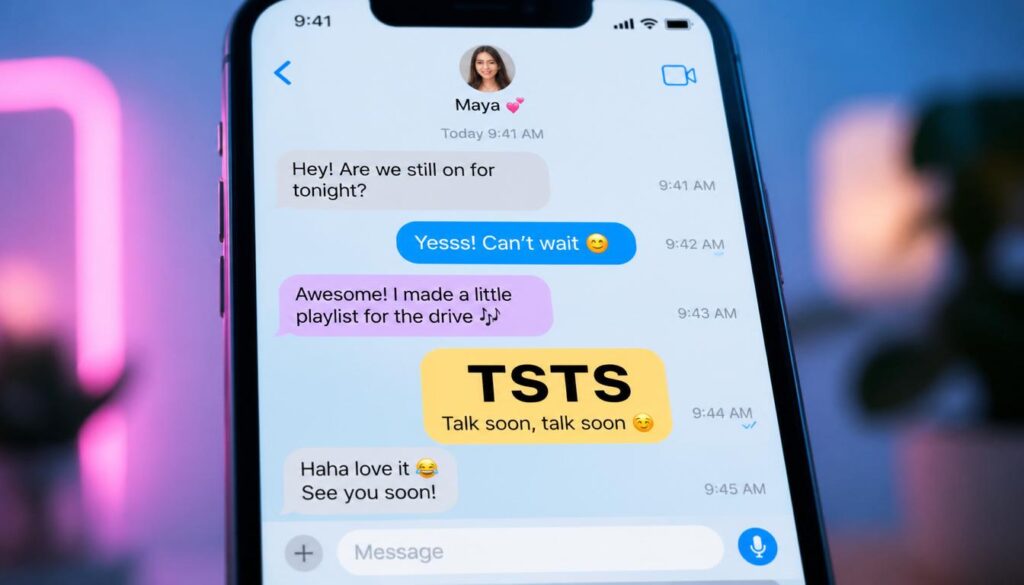
Another less common meaning is “Talk Soon, Text Soon.” This version usually appears when someone is ending a conversation and plans to continue chatting later.
The Most Common Meaning: Too Soon To Say
The phrase Too Soon To Say is used whenever the outcome of something is still unknown.
In simple words, it means:
- The answer isn’t clear yet.
- More information is needed.
- Nothing has been decided.
- It’s better to wait before making a conclusion.
This meaning appears far more often than any other interpretation of TSTS.
Why People Use “Too Soon To Say”
Modern messaging is built around speed. Nobody wants to type long explanations every time they’re uncertain. So, people often choose abbreviations that save time while still getting the point across.
Common reasons include:
- Saving time while texting
- Keeping conversations flowing naturally
- Avoiding lengthy explanations
- Responding quickly during busy chats
Instead of writing:
“I’m not sure because we’re still waiting for confirmation.”
Someone simply writes:
“TSTS.”
It says almost the same thing, only much faster. Pretty handy, honestly.
Can TSTS Mean Something Else?
Yes, although it’s much less common.
Sometimes TSTS means “Talk Soon, Text Soon.” This version is usually used as a friendly goodbye before ending a chat.
For example:
A: I have to leave for work now.
B: No worries, TSTS!
Or:
A: Busy right now.
B: Okay, TSTS.
In these examples, the phrase isn’t about uncertainty. Instead, it’s simply promising to continue the conversation later.
Which Meaning Should You Assume?
In most cases:
| Situation | Likely Meaning |
|---|---|
| Discussing future plans | Too Soon To Say |
| Waiting for results | Too Soon To Say |
| Ending a conversation | Talk Soon, Text Soon |
| Saying goodbye | Talk Soon, Text Soon |
The surrounding conversation almost always tells you which meaning is intended.
Why Context Is So Important
One of the biggest mistakes people make is assuming every abbreviation has only one definition.
Context determines the meaning of TSTS.
Imagine these examples.
Example One:
“Will the new project launch next week?”
“TSTS.”
Clearly, the speaker means Too Soon To Say.
Now compare it with this:
“I’ve got to go. TSTS!”
Here, Talk Soon, Text Soon makes much more sense.
Whenever you encounter unfamiliar text slang, always read the sentences before and after it. They usually reveal exactly what the sender meant.
Is TSTS a Popular Texting Acronym?
TSTS isn’t among the most common abbreviations like LOL, BRB, or IDK, but it’s becoming more recognizable as online communication keeps evolving.
You’ll most often find it in:
- Casual conversations
- Private text messages
- WhatsApp chats
- Discord servers
- Group chats
- Instagram DMs
- Snapchat conversations
Because it’s not universally known, many people still search its meaning after seeing it for the first time. That’s perfectly normal, really.
Real-Life Examples of TSTS in Text Messages
Here are some everyday situations where people naturally use TSTS.
Example 1: Future Plans
Alex: Are we moving offices this summer?
Jamie: TSTS. Management hasn’t confirmed anything yet.
Example 2: Sports
Chris: Think our team will reach the finals?
Taylor: TSTS. Still lots of games left.
Example 3: Family Plans
Mom: Are Grandma and Grandpa visiting next weekend?
Dad: TSTS. They’re checking their travel schedule.
Example 4: School
Student: Have the exam dates been announced?
Friend: TSTS. The teacher said next week.
Example 5: Ending a Chat
Sam: I have another meeting.
Jordan: Okay, TSTS!
Each conversation makes the intended meaning fairly obvious.
TSTS Compared with Other Popular Text Abbreviations
Many abbreviations express uncertainty, but each has a slightly different purpose.
| Abbreviation | Meaning | Best Used When |
|---|---|---|
| TSTS | Too Soon To Say | Outcome isn’t known yet |
| IDK | I Don’t Know | You genuinely don’t know |
| TBD | To Be Decided | Official decision hasn’t been made |
| N/A | Not Applicable | Information doesn’t apply |
| LOL | Laugh Out Loud | Expressing amusement |
| BRB | Be Right Back | Leaving briefly |
Notice how TSTS specifically suggests that an answer may become available later, while IDK simply means the person doesn’t know.
When Should You Use TSTS?
Use TSTS when:
- You’re waiting for confirmation.
- Future plans haven’t been finalized.
- Results aren’t available yet.
- Decisions are still pending.
- You want a quick reply.
For instance:
“Will the weather be good this weekend?”
“TSTS.”
Simple, clear, and natural.
When You Shouldn’t Use TSTS
Although useful, TSTS isn’t suitable everywhere.
Avoid using it:
- In professional emails
- Business reports
- Academic writing
- Legal documents
- Formal workplace communication
- Customer support responses
Many people outside texting culture may not recognize the abbreviation, leading to confusion.
When clarity matters more than speed, it’s usually better to write the full sentence.
Why Modern Communication Uses So Many Acronyms
The way we communicate has changed dramatically over the last two decades.
People now send hundreds of short messages every week. Because of this, abbreviations have become part of everyday language.
Instead of typing:
“I’ll respond after I receive confirmation.”
Someone might simply write:
“TSTS.”
These shortcuts make conversations quicker while still conveying the intended meaning.
They also fit perfectly into platforms where people expect rapid replies.
The Origin and Evolution of TSTS
Unlike famous abbreviations such as LOL or BRB, the exact origin of TSTS isn’t well documented. That’s actually pretty common with internet slang. Many acronyms begin in small online communities before gradually spreading through messaging apps, forums, and social media.
The meaning “Too Soon To Say” likely became popular because it’s a natural phrase people already used in everyday conversation. As texting evolved, users shortened it to save time.
Today, you’ll occasionally spot TSTS in:
- Personal text messages
- Online discussion forums
- Gaming chats
- Group messaging apps
- Social media conversations
While it isn’t among the world’s most frequently used abbreviations, its usage has steadily grown as people look for faster ways to communicate uncertainty.
How TSTS Is Used on Different Platforms
The meaning of TSTS generally stays the same across platforms, but the style of conversation can influence how often it’s used.
On WhatsApp, people mostly use TSTS in conversations with family, friends, or coworkers when discussing plans.
Example:
“Dinner tomorrow?”
“TSTS. Waiting to hear back from everyone.”
Snapchat
Snapchat conversations are usually quick and informal, making abbreviations feel natural.
Example:
“You coming tonight?”
“TSTS 😂”
The emoji adds personality, but the meaning stays the same.
Instagram Direct Messages
Instagram DMs often involve casual chatting.
Someone might reply:
“Vacation confirmed?”
“TSTS for now.”
It’s short, friendly, and keeps the conversation moving.
Discord
Gaming communities frequently discuss upcoming events, updates, and tournaments.
Example:
“Will the server open today?”
“TSTS. Admin hasn’t announced anything.”
Facebook Messenger
Messenger conversations between friends often include abbreviations like TSTS, especially when making plans.
Example:
“Movie tonight?”
“TSTS. Waiting on Sarah.”
Reddit and Online Forums
On Reddit or discussion boards, you’ll occasionally see TSTS when people speculate about rumors, product launches, or upcoming announcements.
Example:
“Will the next update include new features?”
“TSTS until the developers confirm it.”
Is TSTS Still Popular in 2026?
Yes—but it’s still considered a moderately common abbreviation rather than a mainstream one.
Most people immediately recognize abbreviations like:
- LOL
- OMG
- BRB
- IDK
TSTS, however, is more niche. Some users know it well, while others encounter it for the first time and search its meaning online.
That doesn’t make it outdated. Instead, it’s simply one of many specialized texting acronyms that appear depending on the conversation.
TSTS vs IDK: What’s the Difference?
These two abbreviations are often confused because both relate to uncertainty.
The important difference is this:
TSTS means the answer isn’t available yet.
IDK means the speaker doesn’t know the answer.
Consider these examples.
Question:
“Will the concert happen?”
Answer:
“TSTS.”
This suggests the answer may become clear later.
Now compare:
“What’s John’s phone number?”
“IDK.”
Here, the person simply doesn’t know.
It’s a small distinction, but it changes the meaning quite a bit.
TSTS vs TBD
People also confuse TSTS with TBD (To Be Decided).
Here’s the difference.
TBD usually refers to an official decision that hasn’t been made.
For example:
“The meeting location is TBD.”
On the other hand:
“Will the meeting happen?”
“TSTS.”
The event itself is still uncertain.
Think of TBD as describing unfinished plans, while TSTS expresses uncertainty about an outcome.
Common Mistakes People Make
Many first-time readers misunderstand TSTS because abbreviations often have multiple meanings.
Some common mistakes include:
- Assuming it always means “Talk Soon, Text Soon.”
- Believing it’s a negative response.
- Thinking it means “I don’t know.”
- Using it in formal business communication.
- Ignoring the surrounding conversation.
Almost every misunderstanding disappears once you consider the context.
Conversation Scenarios
Here are a few realistic situations where TSTS fits naturally.
Making Weekend Plans
Emma: Are we going hiking Saturday?
Liam: TSTS. The weather forecast keeps changing.
At Work
Employee: Has the project deadline changed?
Manager: TSTS. Leadership is still discussing it.
Although understandable, in many workplaces it’s still better to write the full phrase instead of the abbreviation.
Dating
Taylor: Are we meeting this Friday?
Jordan: TSTS. I might have to travel for work.
The reply sounds polite without making promises.
Gaming
Player: Will the update release tonight?
Moderator: TSTS until the developers post an announcement.
Gaming communities often use abbreviations like this because discussions move quickly.
When Not to Use TSTS
Knowing when not to use an abbreviation is just as important.
Avoid using TSTS if:
- The reader may not understand texting slang.
- You’re communicating with clients.
- You’re writing professional documents.
- Precision matters.
- Instructions must be completely clear.
Instead, write something like:
“It’s too early to confirm.”
or
“We’re still waiting for additional information.”
Those versions leave no room for confusion.
Does TSTS Have Any Negative Meaning?

No.
One reason people like TSTS is because it’s emotionally neutral.
It doesn’t express:
- Anger
- Frustration
- Excitement
- Sarcasm
- Disappointment
Instead, it simply communicates that the situation hasn’t been decided yet.
That’s why it works well in friendly conversations.
Why Context Always Comes First
One important fact about internet slang is that context determines meaning.
The exact same abbreviation can communicate different ideas depending on the conversation.
For example:
“TSTS.”
Without context, nobody knows exactly what it means.
But after reading the surrounding messages, the intended interpretation becomes obvious.
That’s true not only for TSTS, but also for dozens of other texting abbreviations used every day.
Expert Insight
Language experts often point out that abbreviations aren’t replacing language—they’re adapting it.
Short forms like TSTS exist because digital conversations reward speed. People naturally shorten familiar phrases while still expecting others to understand them from context.
As messaging continues to evolve, new acronyms will appear while older ones disappear. TSTS represents one small example of how online communication keeps becoming faster and more efficient.
Final Thoughts
By now, you should have a clear understanding of what TSTS means in text and why it appears in so many casual conversations.
In most situations, TSTS means “Too Soon To Say,” expressing that an answer or outcome isn’t available yet. Less commonly, it can also mean “Talk Soon, Text Soon,” especially when ending a conversation.
The key takeaway is simple: context determines the meaning of TSTS. Reading the surrounding messages will almost always tell you which interpretation fits best.
As texting, social media, and online communication continue to evolve in 2026 and beyond, understanding abbreviations like TSTS will help you communicate more confidently and avoid unnecessary confusion.
Frequently Asked Questions
What does TSTS mean in text?
TSTS most commonly stands for “Too Soon To Say.” People use it when an outcome or decision hasn’t been confirmed yet. In some informal conversations, it can also mean “Talk Soon, Text Soon,” although this interpretation is much less common.
Is TSTS the same as IDK?
No. IDK means “I Don’t Know,” while TSTS suggests that the answer isn’t available yet because more information or time is needed. TSTS implies uncertainty that may be resolved later, whereas IDK simply states a lack of knowledge.
Is TSTS appropriate for work emails?
Generally, no. While coworkers may understand it in casual chats, formal emails and professional communication should avoid texting abbreviations. Writing the complete phrase is clearer and more professional, reducing the chance of misunderstanding.
Is TSTS still used in 2026?
Yes. Although it isn’t as widely recognized as abbreviations like LOL or BRB, TSTS continues to appear in text messages, WhatsApp, Discord, Instagram DMs, and other casual online conversations where people discuss uncertain plans or future events.