
If you’ve come across the term JSP and wondered what it actually means, you’re not alone. The abbreviation JSP has more than one meaning depending on the context.
In the world of programming, JSP stands for JavaServer Pages, a powerful server-side technology used to build dynamic web applications.
In casual texting, however, some people use it as shorthand for “Just Saying Please,” although this meaning is much less common.
In this comprehensive guide, you’ll learn the JSP full form, meaning, real-world uses, examples, advantages, disadvantages, architecture, request lifecycle, and whether JSP is still worth learning in 2026. By the end, you’ll clearly understand when and where JSP is used and how it compares with modern web technologies.
What Does JSP Mean?
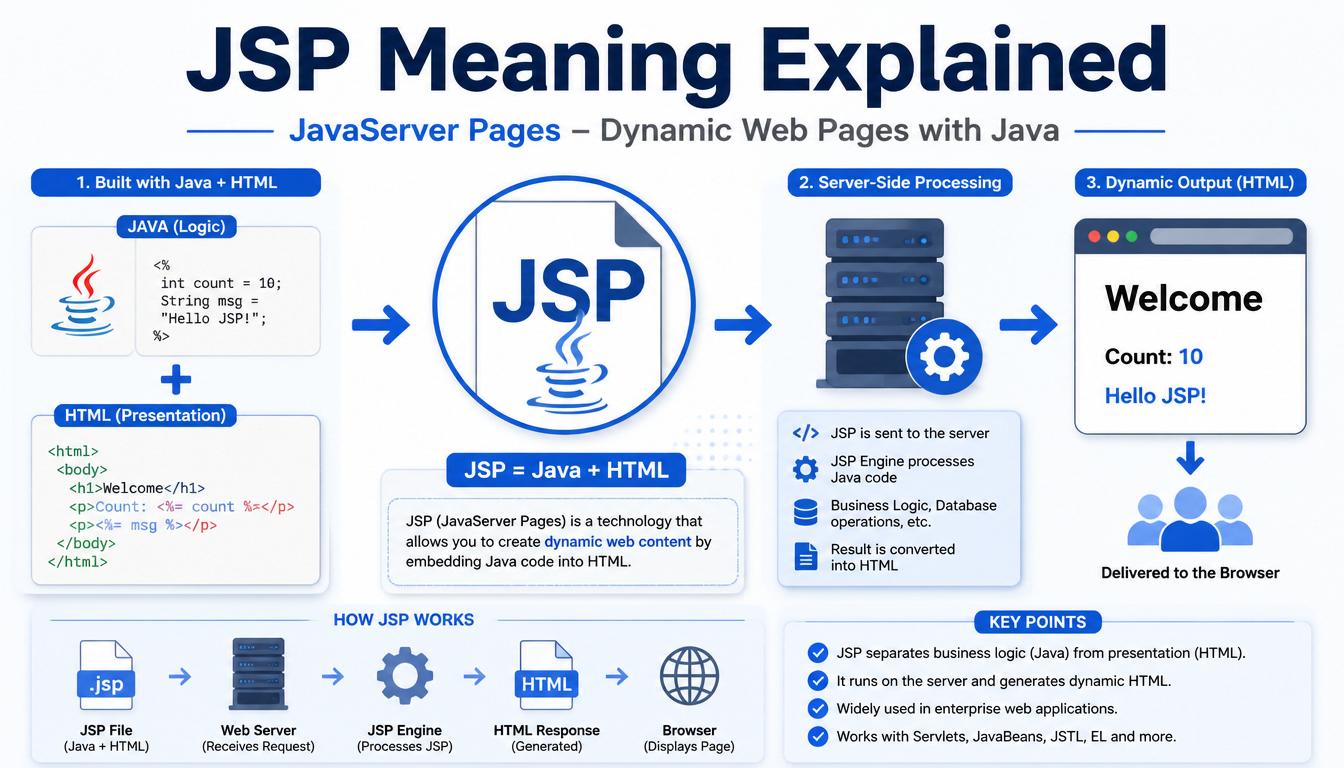
JSP most commonly stands for JavaServer Pages. It is a server-side web technology developed to help programmers create dynamic web pages using the Java programming language.
Unlike a static HTML page, a JSP page can generate content dynamically based on user input, database records, sessions, or other server-side processes.
Depending on the context, JSP may also refer to:
| Meaning | Full Form | Common Usage |
|---|---|---|
| JSP | JavaServer Pages | Web development |
| JSP | Just Saying Please | Rare internet slang |
For nearly all technical discussions, interviews, and programming tutorials, JSP refers to JavaServer Pages.
JSP Full Form Explained
The full form of JSP is JavaServer Pages.
It is a server-side scripting technology that allows developers to combine HTML with Java code to create interactive and dynamic websites.
JSP was introduced by Sun Microsystems and later became part of the Java EE (Enterprise Edition) platform, now known as Jakarta EE.
Developers commonly use JSP to build:
- Business applications
- Banking systems
- Hospital management software
- University portals
- Enterprise websites
- Customer management systems
Although newer frameworks exist today, many enterprise organizations still maintain applications built with JSP.
JSP Meaning in Programming
In programming, JSP is a technology used to create dynamic web pages using Java.
Instead of sending a fixed HTML file to every visitor, JSP generates customized content on the server before the page reaches the user’s browser.
For example:
- A shopping website displays different products for each customer.
- A banking portal shows account information after login.
- A university website displays personalized student results.
- An online booking system generates unique reservation details.
These are common scenarios where JSP plays an important role.
How Does JSP Work?
A simple explanation is that the browser requests a page, the server processes the JSP file, and the browser receives the generated HTML.
The process looks like this:
- The user opens a JSP page in the browser.
- The web server receives the request.
- The JSP engine converts the JSP file into a Java Servlet (only the first time or after changes).
- The Servlet is compiled into Java bytecode.
- The compiled Servlet executes.
- Dynamic HTML is generated.
- The server sends the final HTML page back to the browser.
The browser never sees the Java code. It only receives the finished HTML page.
This server-side execution is one of the biggest reasons JSP became popular for enterprise web development.
JSP Architecture Explained
Many beginner articles skip this topic, but understanding the architecture helps explain why JSP works so efficiently.
A typical JSP architecture consists of these components:
- Client Browser
- Web Server
- Servlet Container (Apache Tomcat, GlassFish, etc.)
- JSP Engine
- Java Servlet
- Database
- Business Logic
The browser sends a request to the server. The server forwards the request to the JSP engine. If necessary, the JSP page is translated into a Servlet and compiled.
The Servlet executes Java code, communicates with databases or APIs, generates HTML, and finally returns the completed webpage to the browser.
This architecture separates presentation from business logic, making enterprise applications easier to manage.
JSP Request Lifecycle
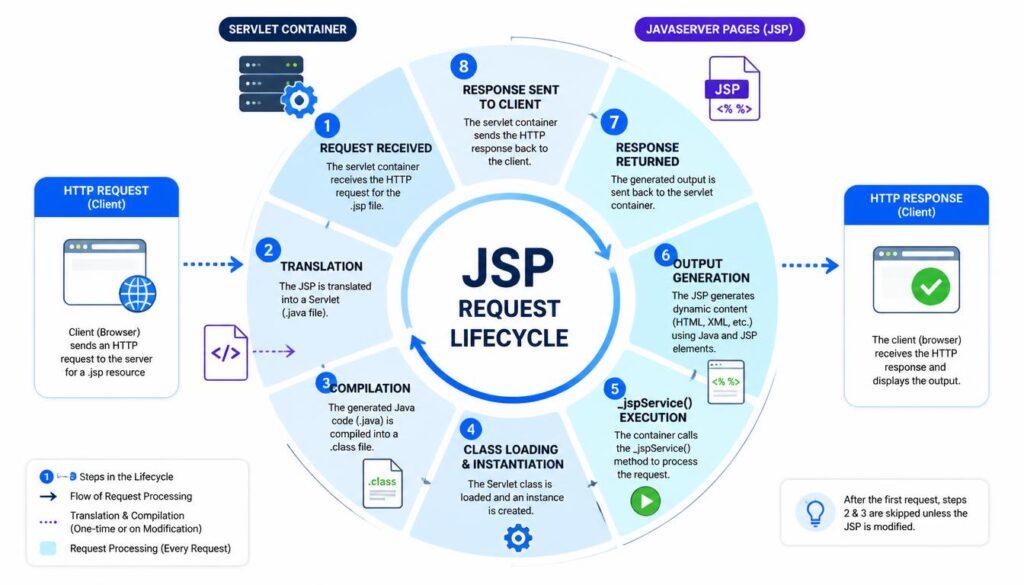
Understanding the JSP lifecycle is important for both interviews and real-world development.
1. Translation
The JSP file is translated into a Java Servlet.
This happens only the first time or whenever the JSP file changes.
2. Compilation
The generated Servlet is compiled into Java bytecode.
3. Class Loading
The compiled class is loaded into memory by the web server.
4. Initialization
The jspInit() method runs once to initialize resources.
5. Request Processing
Whenever users visit the page, the _jspService() method processes each request.
This method generates the dynamic HTML content.
6. Destruction
When the application stops, the jspDestroy() method releases allocated resources.
Knowing this lifecycle helps developers optimize performance and troubleshoot applications more effectively.
Basic JSP Syntax
A JSP file looks similar to an HTML document but includes Java code.
Example:
<%@ page language="java" %>

<html>
<head>
<title>JSP Example</title>
</head>

<body>

<%
out.println("Welcome to JSP!");
%>

</body>
</html>
When the page runs, the visitor sees:
Welcome to JSP!The Java code executes on the server before the HTML reaches the browser.
JSP Scriptlets, Expressions, and Declarations
JSP provides different ways to write Java code inside webpages.
Scriptlet
Scriptlets execute Java statements.
<%
int age = 20;
%>
Expression
Expressions directly display output.
<%= age %>Output:
20Declaration
Declarations define variables or methods for the page.
<%!
String company = "Open Learning";
%>
Although these features are still supported, modern JSP development recommends using Expression Language (EL) and JSTL instead of scriptlets because they make code cleaner and easier to maintain.
Expression Language (EL) and JSTL
Modern JSP applications rarely rely on Java scriptlets.
Instead, developers use:
- Expression Language (EL) for displaying data.
- JSTL (JavaServer Pages Standard Tag Library) for loops, conditions, formatting, and database operations.
Example:
${user.name}This is much cleaner than embedding Java code inside HTML.
Using EL and JSTL improves readability, reduces errors, and follows modern Java development practices.
Key Features of JSP
JSP offers several advantages that made it one of the most popular Java web technologies.
Some of its major features include:
- Dynamic content generation
- Easy integration with Java
- Platform independence
- Automatic compilation
- Session management
- Database connectivity
- Reusable components
- Support for MVC architecture
- Easy deployment on Java servers
- Secure server-side execution
These capabilities make JSP suitable for medium and large-scale enterprise applications.
JSP Implicit Objects
JSP automatically provides several built-in objects that developers can use without creating them manually.
Some common implicit objects are:
- request – Stores client request information.
- response – Sends responses back to users.
- session – Maintains user sessions.
- application – Shares data across the application.
- out – Prints output to the webpage.
- config – Holds servlet configuration.
- pageContext – Provides access to JSP page attributes.
These objects simplify development and reduce repetitive coding.
Real-Life Uses of JSP
Although many companies have adopted newer technologies, JSP continues to power thousands of business applications around the world.
Common use cases include:
- Online banking systems
- Insurance portals
- Government websites
- ERP software
- Inventory management
- Human resource systems
- Student portals
- Healthcare applications
- Manufacturing software
- Internal business dashboards
Large organizations often continue using JSP because their systems are stable, secure, and already integrated with extensive Java infrastructure.
Why JSP Became Popular
During the early 2000s, JSP solved a major challenge in web development. Developers needed a way to create dynamic pages without manually writing Servlets for every request. JSP made this process much simpler by allowing Java code to be embedded directly within HTML.
It also integrated seamlessly with Java Enterprise Edition, making it an excellent choice for businesses building scalable web applications. At the time, this combination of flexibility and performance helped JSP become one of the leading server-side technologies.
JSP vs Servlets: What’s the Difference?
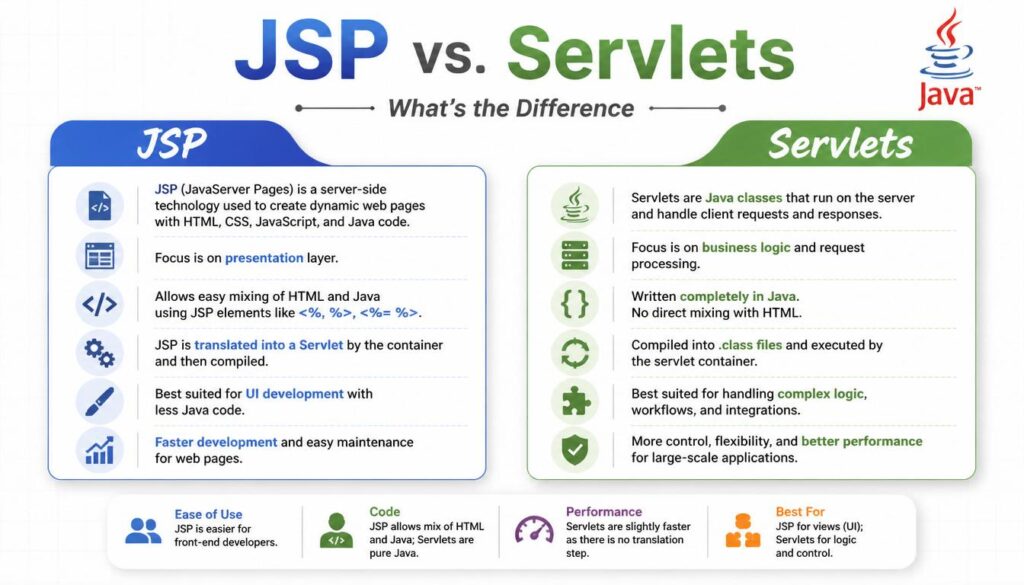
Many beginners confuse JSP and Servlets because both are Java-based web technologies. While they work closely together, they serve different purposes.
A Servlet is a Java class that handles business logic, processes client requests, and generates responses. JSP, on the other hand, is mainly used to design the presentation layer by combining HTML with dynamic Java content.
In simple terms:
- Servlets handle the application’s logic.
- JSP handles the user interface.
When a JSP page is requested, the server actually converts it into a Servlet behind the scenes before executing it. This is why understanding Servlets helps you understand how JSP works internally.
JSP vs PHP vs JavaScript
Although these technologies are often compared, they have different roles in web development.
| Technology | Primary Purpose | Runs On |
|---|---|---|
| JSP | Dynamic server-side web pages using Java | Server |
| PHP | Server-side scripting | Server |
| JavaScript | Interactive web pages | Browser (and server with Node.js) |
JSP
- Uses Java.
- Excellent for enterprise applications.
- Strong integration with Java ecosystems.
- Highly secure and scalable.
PHP
- Easy for beginners.
- Powers many content management systems.
- Large community support.
- Popular for small and medium-sized websites.
JavaScript
- Creates interactive user interfaces.
- Executes in the browser.
- Can also run on the server using Node.js.
- Essential for modern web applications.
Advantages of JSP
JSP offers several benefits that have helped it remain relevant for enterprise software.
1. Platform Independent
Because JSP is built on Java, it can run on Windows, Linux, or macOS without major changes.
2. High Performance
After the initial compilation into a Servlet, JSP pages execute quickly.
3. Easy Java Integration
JSP works seamlessly with Java libraries, APIs, frameworks, and enterprise applications.
4. Supports MVC Architecture
JSP fits naturally into the Model-View-Controller (MVC) design pattern, making applications easier to maintain.
5. Session Management
Managing user logins, shopping carts, and personalized dashboards becomes straightforward using built-in session support.
6. Reusable Components
Developers can reuse headers, footers, templates, and custom tags across multiple pages, reducing repetitive work.
Disadvantages of JSP
Despite its strengths, JSP has some limitations.
Steeper Learning Curve
Developers usually need a solid understanding of Java before learning JSP effectively.
Requires a Java Server
Unlike plain HTML files, JSP pages need a servlet container such as Apache Tomcat.
Older Syntax
Traditional JSP scriptlets can become difficult to maintain in large projects.
Less Popular for New Projects
Many new applications now use frameworks like Spring Boot, React, or Angular, reducing JSP’s popularity for greenfield development.
Is JSP Still Used in 2026?

Yes. JSP is still used, especially in enterprise environments.
Although startups often choose newer technologies, many banks, insurance companies, universities, healthcare providers, and government organizations continue running JSP-based applications that have been maintained for years.
Organizations rarely replace these systems simply because they still perform reliably and are deeply integrated into existing infrastructure.
JSP remains valuable for developers who:
- Maintain legacy enterprise systems.
- Work with Java EE or Jakarta EE applications.
- Support internal business software.
- Build Java-based web applications.
Should You Learn JSP in 2026?
The answer depends on your goals.
You should learn JSP if you want to:
- Become a Java backend developer.
- Work in enterprise software development.
- Maintain legacy Java applications.
- Understand Java web technologies.
- Prepare for interviews involving Java EE.
You may skip JSP if your primary goal is modern frontend development using React, Vue, or Angular.
However, even today, many Java job descriptions still mention JSP as a desirable skill, especially for enterprise roles.
JSP and Modern Java Frameworks
Modern Java development has evolved significantly over the past decade.
Today, developers often choose:
- Spring Boot
- Spring MVC
- Thymeleaf
- Jakarta Faces (JSF)
- REST APIs with React or Angular frontends
These technologies improve code organization and simplify development compared with traditional JSP applications.
Still, JSP remains part of many production systems, and understanding it provides valuable insight into the evolution of Java web development.
JSP and Apache Tomcat
One of the most common servlet containers used with JSP is Apache Tomcat.
Tomcat performs several important tasks:
- Receives browser requests.
- Compiles JSP files into Servlets.
- Executes Java code.
- Manages sessions.
- Returns generated HTML to users.
Without a servlet container like Tomcat, JSP pages cannot execute.
JSP in Enterprise Applications
JSP continues to play an important role in enterprise environments.
Examples include:
- Banking dashboards
- Government portals
- University management systems
- Hospital information systems
- Payroll software
- Customer relationship management (CRM) platforms
- Inventory management systems
- Enterprise resource planning (ERP) software
These systems often prioritize long-term stability, security, and maintainability over adopting the latest frontend technologies.
JSP Meaning in Chat
Outside programming, JSP occasionally appears in online conversations.
One interpretation is:
JSP = Just Saying Please
This usage is uncommon and usually depends on the context of the conversation.
Examples:
- “Reply soon, jsp.”
- “Join the meeting, jsp.”
- “Call me later, jsp.”
Because this meaning is relatively rare, it’s important not to assume that every use of “JSP” refers to chat slang. In most professional or technical contexts, it almost always means JavaServer Pages.
Real-World Examples of JSP
Here are some examples that show how JSP is used in different situations.
Programming Example
“Our company developed the employee portal using JSP and Java.”
Education Example
“Students learn JSP to understand server-side web development.”
Business Example
“The accounting software still runs on a JSP-based application.”
Chat Example
“Message me later, jsp.”
In each case, the surrounding context makes the intended meaning clear.
Common Mistakes About JSP
People new to web development often make a few common mistakes.
- Assuming JSP and JavaScript are the same technology.
- Thinking JSP is a programming language rather than a server-side technology.
- Believing JSP is completely obsolete.
- Writing large amounts of Java code directly inside JSP pages instead of using EL and JSTL.
- Ignoring MVC architecture and mixing presentation with business logic.
Avoiding these mistakes will help you build cleaner and more maintainable applications.
Best Practices for Using JSP
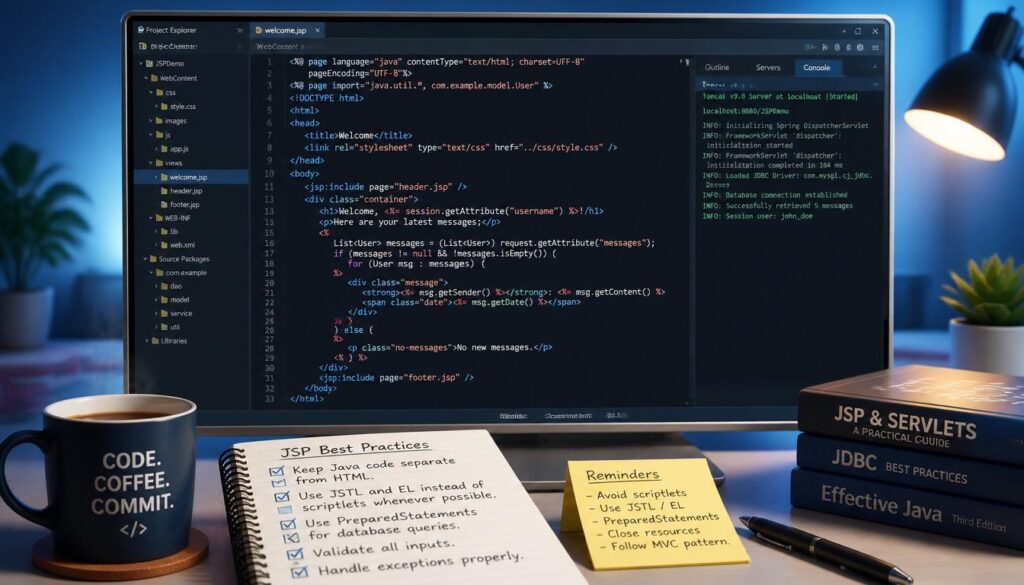
If you’re developing with JSP today, follow these recommendations:
- Use Expression Language (EL) instead of Java scriptlets whenever possible.
- Prefer JSTL for loops and conditional logic.
- Separate business logic into Servlets or service classes.
- Follow the MVC architecture.
- Validate user input on the server.
- Keep JSP pages focused on presentation.
- Organize reusable templates for headers, footers, and navigation.
These practices improve readability, maintainability, and security.
Key Takeaways
By now, you should have a clear understanding of what JSP means and where it fits in modern web development.
The most important points are:
- JSP stands for JavaServer Pages.
- It is a server-side technology based on Java.
- JSP creates dynamic web pages by generating HTML on the server.
- Every JSP page is translated into a Servlet before execution.
- JSP remains widely used in enterprise and legacy applications.
- Modern development often combines Java backends with newer frontend frameworks, but JSP is still an important technology to understand.
Frequently Asked Questions
What does JSP stand for?
JSP stands for JavaServer Pages. It is a Java-based server-side technology that allows developers to build dynamic web pages by embedding Java functionality into HTML. It remains an important part of many enterprise Java applications.
Is JSP the same as JavaScript?
No. JSP and JavaScript are completely different technologies. JSP runs on the server and generates HTML before sending it to the browser, while JavaScript primarily runs inside the user’s browser to create interactive web experiences.
Is JSP still worth learning in 2026?
Yes, especially if you’re interested in Java backend development or enterprise software. Many organizations continue to maintain JSP-based systems, and understanding JSP provides a strong foundation for learning Java web technologies and frameworks.
What does JSP mean in texting?
In texting, JSP can sometimes mean “Just Saying Please.” This interpretation is relatively uncommon. In technical discussions, education, and software development, JSP almost always refers to JavaServer Pages.
Conclusion
Understanding the JSP meaning is important because the acronym has different interpretations depending on context. In the world of software development, JavaServer Pages is by far the most common meaning. JSP has powered dynamic Java websites for decades and continues to support many enterprise applications in 2026.
Although newer frameworks like Spring Boot, React, and Angular dominate modern development, JSP remains relevant for maintaining legacy systems, learning Java web architecture, and understanding how server-side rendering works.
Whether you’re a student, developer, or simply curious about the term, knowing what JSP is and how it works—gives you a solid foundation in Java web development.
Meta Description:
JSP Meaning Explained: Full Form, Uses & Real Examples 2026. Learn what JavaServer Pages is, how JSP works, its architecture, uses, examples, and modern relevance.